
One of the key points TAG’s code of conduct is giving space for soldiers to train.
The recent Respect The Range campaign managed to raise an awareness that our military lands are working environments that support the activities of our defence forces, however it did very little to educate. The campaign encouraged irrational and baseless fear but offered zero practical advice. It was interesting to find the imagery in the campaign contradicted the Aldershot Standing Orders:
When the training undertaken does not appear to present a risk to civilians, or where a unit can accept civilians walking or riding horses on the area being used for training, then it is HQ SE Trg Estates policy not to exclude those civilians.
Aldershot Training Area Standing Orders – 10. CIVILIAN ACCESS TO MOD TRAINING LAND
However, it remains the responsibility of all of us – dog walkers, joggers, cyclists, picnic organisers and equestrians – to let soldiers get on with the business of training without interruption.
The first and perhaps most important step we can all take is be aware of what is going on. It’s not always easy but even with the best camouflage there are signs soldiers are out and about.
So with that in mind, what should we be looking out for?
Signs Of Use
Camouflage and concealment can mean actually seeing soldiers happens when its too late. But there are always other non-direct visual clues telling you who might be there. Some are subtle and some really obvious if you know what to look for and understand the signficance. Here’s a short guide:
Portaloos
The Aldershot Standing Orders tell us digging of field latrines is forbidden and any unit who fails to book portaloos will be prevented from training in the area.
Why? Principle reason is the habitat and the soft, sandy and well-drained soils are naturally low in nutrients. This makes the heathland a special place where only specialist flora and fauna can survive.

A platoon of soldiers depositing nutrients – as humans do – starts to upset the natural balance and make changes.
The presence of portaloos tells us someone is likely to be using the immediate area. The number of portaloos can help inform too with the Standing Orders stating the requirement of 1 toilet to 25 soldiers. More than one toilet hints at a bigger exercise with more troops which indicates more chance of encountering them.
Seeing the portaloos is a regular thing and more than a little hint someone could be training. Nothing is an absolute but see the plastic bogs as a marker, a clue, to suggest someone might be present and training.
Tracks and Markers
The soft soil is a rich source of who is, or is not, there. Fresh vehicle tracks stand out like a sore thumb in the sand and if you see them there is a very good chance training may be present. Not all tracks are military for the wildlife folks will drive onto the land in search of their cows or clear scrub but the safest bet is to presume military use.
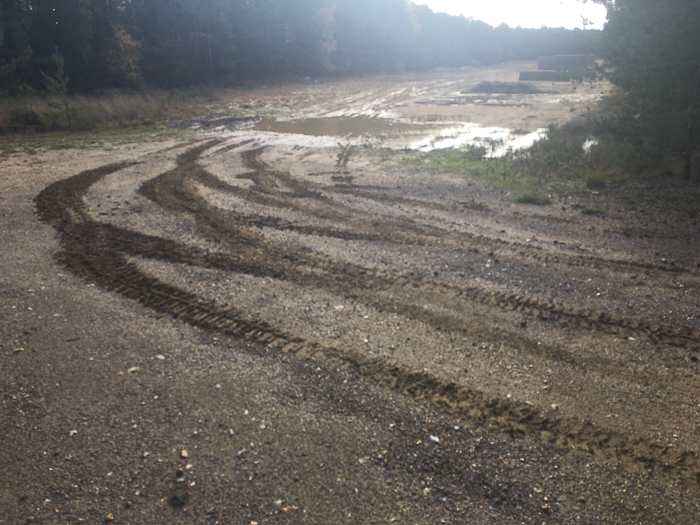
Aldershot Standing Orders limit off-road driving to specific areas – Long Valley and Bagshot Heath South – so vehicles are most likely (but not exclusively) going to be encountered on the main tracks across all other areas. Even in the off road training areas the routes used are both obvious and easy to avoid by sticking to the narrow single track paths.

Direction markers on the main tracks are a good sign the route might be use. Combine this with churned up mud and there is every chance this track is in active use. It is probably time to raise awareness of what is going on, and consider another route rather than continue on anything showing these signs.

Vehicles have priority. Pull well off the track and let the vehicle drive past – there is an estate-wide speed limit in force so it might take a short while – and don’t forget to smile and wave. Make those who work and serve feel welcome.
Map Reading Exercise Boards
Map reading happens just about everywhere on the estate. Soldiers can often be seen either singly or in small groups consulting a map. Its no unheard of for locals to correct and adjust where they think they are to the correct point on the map.

The boards we see hanging from trees are the point of interest. Granted its not as spectacular as Jubilee Clump at the top of Caesars Camp but these are what the wandering soldiers clutching a hypothetical list of six figure grid references are seeking.
Discreet and often overlooked they are another indicator – a bit like the portaloos – that military training might be underway.
Map reading is a vital skill for anyone, not just the military. Its also very low risk to those training or civilians. Just be prepared to step aside and let troops past…and point them in the correct direction if they appear lost.
The Obvious and Subtle
Occasionally the army will put up really obvious signs telling everyone exactly what is going on.

A regular feature of training in Long Valley lately is forestry operations and teaching soldiers how to use chainsaws. The gates tend to be locked but we know the local community are riding, jogging and walking in the area. No one is reporting a busy space and the lands – apart from the 1 acre or so of where the tree felling is taking place – can hardly be described as busy.
Of the 950 acres behind the fence just 1 acre is needed for chainsaw training and sticking to the remaining 949 and typically empty acres is very easy.
The less subtle signs of training are taped off trails. The best deterrent used is what is termed mine tape and soldiers use it to mark no go or dangerous stuff like minefields.

But it can be seen strung across trails from time to time. If tape isnt available then soldiers will improvise; twine and logs have all been seen and reported as “trail closed” indicators in the past.
Mountain bikers should take particular note and heed the sign – if the trail is taped off then there is a good chance something is going on.

TAG positively encourage anything that helps the community avoid localised training. Find another trail. Use an alternative.
There are plenty to choose from and this guide will help.
Summary
TAG do not believe for one minute we have listed everything. Nor have we got it all 100% right. We would rather be about right than be precisely wrong by doing nothing and not sharing what we know. If you spot a glaring error or omission do please get in touch as we see these guidelines and advice as a living, breathing document subject to change as and when more info becomes available. And yes, that offer of corrections and additions extends to DIO…we are not precious about being right when it comes to creating a better world.
“HQ SE Trg Estates tries to maintain a good public relationship with the local population.“
Aldershot Training Area Standing Orders – 13 Public Relations
Given the experiences to date anti-cycling prejudice, closure of car park areas, fences and locked gates irrespective of use – The question TAG ask: is this the normal approach to public relations of DIO? Or is it just in the Aldershot area? We have seen great community work undertaken by DIO as documented in their magazine – Sanctuary – but regrettably this does not seem to extend to the communities surrounding the Aldershot lands, for the moment at least. TAG remain optimistic but it does raise questions about why such hostility is necessary?
Nevertheless we can all play our part and maintain the excellent relations with the army.
Soliders need to train and we need to give them the space to do whatever it takes. Being aware of what is going on, where training is, and when its underway, is part of the deal to maintain casual access.
So its down to us, individually and collectively, to do the right thing and the thing right. Spread the word and knowledge. Set and maintain standards by being the responsible recreational users the army wants to see…at a distance.
Community action for a positive outcome is what will work for all, irrespective of civil servant or political agendas.
References:
Standing Orders Aldershot Training Areas and Miscellaneous Training Facilities Version 1.0 Dated 31 March 2021
 Trail Action Group
Pingback: Deleted Evidence? Gather Your Own… | Trail Action Group