DIO Public Safety Announcement; Single Track Is Dangerous (Spoiler Alert: No It Isn’t)

3rd April 2024 – Update. TAG have gathered more evidence to demonstrate how DIO’s ideas around safety are misplaced. Section added below.

Whenever we hear DIO pass comment on matters related to MTB and cycling, it’s difficult to see a connection between the abstract ideas, and the reality. The basic theory is fine but the nuanced detail and most importantly, hard facts and real insight, are absent.

If you are a regular reader of the TAG blogs and don’t need to watch a series of videos picking DIO’s “policy” apart, feel free to scroll to the end and write to your MP asking them to start pressing the case for DIO to stop treating cyclists with contempt, recognise the reality of how we use the lands and to treat cyclists with respect.

If not, do please read on.

Faced with new byelaws* DIO will need to be seen to do something to accommodate cyclists. So far the mood music TAG has picked up on suggests cycling on some fire/vehicle roads will be permitted, but the single track we use and love will be strictly off-limits.

How a legal definition is going to read and be interpreted will be very interesting. But it will be even more entertaining to sit back and watch DIO actually try enforce the unenforceable.

The experience driving around the fire roads in a pickup cannot be considered the same as riding a bike along the 400 miles or so of informal routes.

Why is single track off limits? Apparently it’s not suitable because the speeds cyclists can reach are dangerous.

Yes, according to DIO single track is inherently more dangerous than a fire road so we must never use them for the safety of all. Even if no one else is there.

There are risks and costs to action. But they are far less than the long range risks of comfortable inaction.

John. F. Kennedy

TAG have a few observations on this mindset.

Firstly, we must suspend the reality of vehicles are using the fire roads because, obviously, there is some magic force field that prevents cyclists ever coming close to one.

TAG would like to see the risk assessment for this one. How do cyclists and vehicles avoid each other if they are compelled to share the space? The evidence base to support this policy would be appreciated as well.

Then we must also forget that sometimes single track goes uphill.

Some of if doesn’t and gravity is a great asset, but DIO are ignoring the simple laws of physics here. Some objective evidence would be required (Civil Service contract of employment and Standards in Public Life) for us to be convinced, but TAG concludes the evidence won’t exist. Or DIO have deleted it for “business purposes”.

If DIO can ignore ministers, then ignoring the laws of physics is simple. Hands up who can cycle uphill at 20mph? Anyone?

Next we must ignore the flat bits. With the heart rate running close to 180bpm a pace close to 10 mph is a good effort on a dry day. Just check the Strava stats of a few of the single track segments. Then try sustaining that level for a full ride. Anyone who can hold that pace should be in the olympics or racing professionally and at this point we are deep into edge cases. Most mere mortals want a nice day out and that includes a bit of single track.

And last but not least we need to suspend reality and forget there are fire roads that end in a dead end with tracks leading off in all directions. Or terminate in a locked gate.

None of it makes any sense or reason, but just as the locking of gates on a vacant Long Valley has taught TAG…never, ever expect logic or good reason to apply when DIO set their hearts on achieving a bonkers agenda.

He who is not courageous enough to take risks will accomplish nothing in life.

Muhammad Ali

If DIO would like to get in touch and share evidence, then please use info@trailactiongroup.co.uk to drop us a line.

It’s also galling to watch other user groups, typically organised events, runners, orienteering groups or the Pony Club, seeing no such restrictions. The drag hunt didn’t stick to the fire roads…why should we?

Hypocrisy? Double standards? Bias and prejudice? TAG certainly think so. But before we seek some help with accountability, lets have a look at some evidence.

A Beginners Guide to Single Track Use

As part of our service and in spirit (if not in practice) of postive collaboration and cooperation, we have pulled together some short explainer videos. These will give DIO staff a deeper insight into how MTB use the lands, and what measured speeds we can actually achieve when using single track.

Is this data perfect? No, not at all. But its a lot better than nothing, or basing policy on thoughts and feelings.

But first we need to highlight a DIO spoiler alert; MTB is not as fast as you want to think it is.

First up, a short video on what DIO may think is acceptable and safe to use a bicycle:

Just like sticking to the fire roads, watching a video is dull as dishwater and unnecessary. So we won’t be wasting too much time and keep the video short. Just enought to bore the viewer into getting why fire roads are not where the pleasure really is.

Next up, some single track with a spot of downhill:

We are not saying speeds can peak, but to set policy that all single track is dangerous when only part may (stress may) carry higher risk is neither rational or reasonable.

Nevertheless, that video is likely to give DIO kittens.

It’s got tree roots. And off camber slopes. And it’s downhill. Some sections have a rooty, camber and slope combo. Its loaded with more perceived risk than Russian roulette with 5 live chambers…but feel free to fast forward to the end and see every MTB rider arrive alive and well at the next fire road.

Next up we have a little track that runs downhill, but again the speeds are kept low by the nature of the trail and terrain. It twists and carries natural features that slow riders:

Check the speed. It’s all single track and some downhill but there is a good line of sight.

Plenty of natural, twisting track here to keep a downhill speed low.

Risks where speeds can be higher can be mitigated by design. But this would need a) DIO to accept cycling was welcomed and b) cooperation with folks like TAG who understand more about than MTB that someone who drives around the lands in a pickup or sits behind a desk. This should be something your MP can help with and by writing to them (read on) it helps press for DIO to change.

Now we have a section of single track/multi-use in a part of the Aldershot lands where military training is not permitted thanks to the rules in the Aldershot Standing Orders:

Section of multi use track that DIO maintain is not safe for cyclists. Even if it’s flat and no troops present. TAG have given up hoping DIO will apply logic to anything.

And here we have the classic dilemma DIO are unlikely to be able to reason away and another example of where DIO logic meets reality. And the “logic” falls over. The fire road ends and three single track routes carry on:

Are DIO really expecting us to just turn around because the fire road ends? When decades of use has established the trails? Honestly?

Here’s another great example. The fire road runs into a locked gate:

These gates block a long-standing access point. Local MP Ranil Jayawardena reassured residents some new gates were coming to Long Valley 3 years ago, but DIO have yet to deliver.

This section of single track is in Long Valley. It’s an undulating, twisting route and speeds are hardly peaking. The finish is uphill and it’s a short and steep one. Check out the heart rate at the end to see the effort expended:

The rider is 56 years old and has maintained fitness over the decades by riding on the lands. A heart rate peak of 193bpm is high for some but normal in this instance.

The best kind of single track is one that demands 100% concentration. Thinking about the ride and nothing else becomes so immersive the worries carried onto the lands slip away as both mind and body are exercised, reset and refreshed. The rider, whose heart rate peaked at 193bpm is 56 and remains fit thanks in part to these lands and trails.

The ethos and heart of the matter for MTB is living in the now and engaging mind, body and spirit with the ride and what is going on. In military speak it’s called situation awareness and this moment is not available to anyone stuck inside a pickup cab.

“I am always doing that which I cannot do, in order that I may learn how to do it.”

Pablo Picasso

This is why we ride single track. It goes to the core of what it is to be a cyclist and a mountain biker. DIO must realise and accept the fire roads are just not going to cut it.

If anyone knows of other completely bonkers examples of where fire roads terminate and leave the cyclists with nowhere to go, do please send us a location. Or better still, video it!

No prizes for the best example, but a really warm glow is assured knowing you are holding DIO to account for their policy and actions.

Updated section

TAG have found a place where MTB can pick up the kind of speeds DIO find troubling. Just ride any downhill fire road and watch the pace climb as gravity takes over. Fire roads are where vehicles must be used. The Aldershot Standing Orders (Page 13, 37.d) says so and this narrow space is what DIO expect cyclists to share “for safety”.

Here’s a run down from the top of Caesars Camp:

DIO worry about speed. Yet the fire roads are where MTB can really pick up and maintain pace. TAG have given up expecting rational, evidence lead policy from DIO…picking apart their daft and emotive thinking is straightforward.

In all cases evidence must be used to set policy. The videos TAG produce count. So does the GPS data everyone gathers. Strava Heatmaps…open source or paid for detail…they are all robust evidence that informs what really goes on. We fully expect DIO to engage and seek to understand exactly what the real issues are, and we will listen to any valid and evidence-based concerns. We will alway seek cooperation and if necessary compromise.

But remember, as taxpayers we are paying for this “service” and TAG firmly believe DIO can and must go a lot further to make sure the local community receives value for every penny.
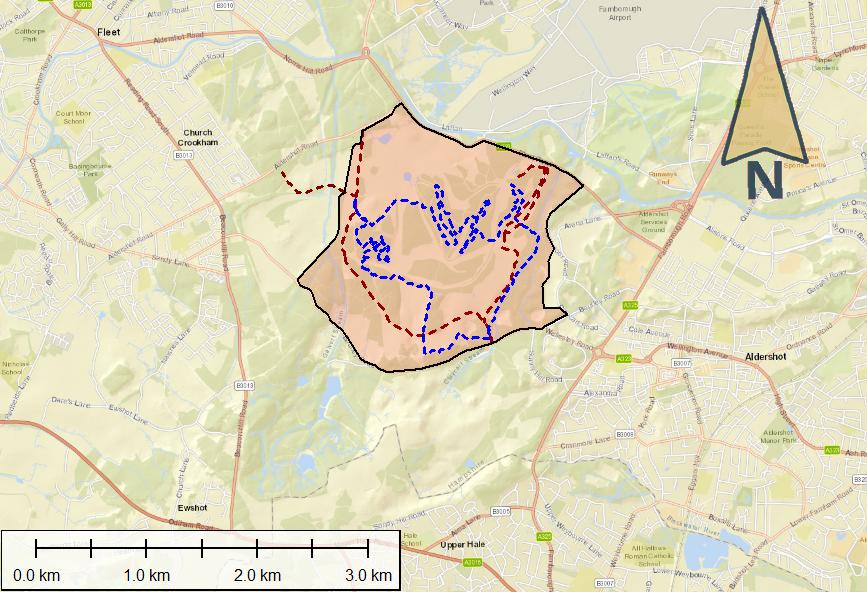
Some of the videos were shot in Long Valley on the single track (blue dashed line) and has avoided the DIO made up tracks (brown dashed) and uses just a little of the test track routes (not shown for clarity). A GPX file of the blue route is available.

If any MTB rider wants to live right on the edge and check out the dangerous single track in Long Valley that featured in some of these videos, we have a GPX file that will guide. WordPress does not like us uploading these file types so just drop us an email to info@trailactiongroup.co.uk and we will send a copy.

Cyclists To Blame

TAG are firmly of the view that any permissive routes will be respected as much as Section 4.2 no cycling ban of the current byelaws. There is plenty of evidence to suggest cyclists have ignored the laws since 1976 when they first came out, and there is no indication this will change.

The outcome will continue to see recreational cyclists ignoring what amy daft law drafted out outlaw single track says, and what DIO think is a good idea. Its all unworkable.

Thus DIO will continue to blame (in their opinion) irresponsible cyclists for ignoring the laws, continue to treat the cycling section of society with a mix of prejudice, distain, contempt and arrogance. DIO will continue to use to blame MTB to excuse more fences and locked gates.

The mountain bikers are irresponsible and dangerous, and refuse to follow the law…so we have to block access for all. Mountain bikers will be a handy scapegoat.

It’s all our fault. Even if it isn’t.

But that will suit DIO’s broad agenda and hostility towards all recreational users. Except of course those who pay (carrying a firearm, riding a horse, killing animals, drag hunts, commercial dog walkers…the right sort) or those considered favourable (Ramblers, equestrians) even if their numbers are dwarfed by cyclists.

Never let the facts get in the way of egocentric policy. Based on current behaviour this is likely to be DIO’s reasoning and justification.

What Can You Do?

The truth is more likely DIO are unable or unwilling to accept casual access of any kind, but are unlikely to go up against the walkers or Ramblers. The former are vocal and numerous, and the latter legally prepared and have challenged DIO in the past. Instead they focus on what they think they can control and target what they see is a minority, even when there is zero evidence to suggest they actually need to do anything.

Waste of taxpayer money? TAG certainly believe so.

Any and all letters to the local MPs help raise and maintain the profile of how important recreational use is.

Write to your MP, asking that DIO be compelled to use a firm evidence base to set policy, and that cyclists be given equal status as what those on foot enjoy today. Remind MPs that DIO are ignoring ministers and ask why this is permissible and what do they intend to do about it?

Anything less will see DIO remain openly hostile to a section of society. 4200 people identified as cyclists in the byelaws recreational survey, so it’s hardly a minority view or an edge case pleading here is it?

If you would like to read or remind yourself of the survey, here’s the NE Hants constituency copy:

In this election year remind your MP your vote counts. If it’s true, tell them the lack of support for recreational access to the lands will lose your vote.

The easy way is to use the ever-helpful Write to Them website.

*Latest update on the byelaws. They are due to be published as a stream of radiation pulsing from the heart of our sun after it has consumed its fuel and collapsed under its own weight. Thats in roughly 6.4 billions years from now…but DIO are likely to consider this timeline achievable.

Did You Know – Bird Benefits

Mention ground nesting birds to most mountain bikers and the likely response will be to roll their eyes. Shy and secretive GNBs (as they are known) are a poster species for the area and its wildlife. For a few their presence may be resented, but this view is very much misplaced as the presence of GNBs is one of the area’s greatest asset.

The birds nest here for a simple reason; the terrain is ideal. The open heather fringed with woodland is GNB heaven for nesting and raising chicks and there is one thing the army land has is lots of heather and open space.

Why are they so important? Why bother protecting them? And if they are worthy of protection, what can we do to help?

The short answer is “take care” and it does not mean the end of recreational access…

But first, let’s take a look at the bird in question.

The Nightjar

In the 50 years of living around and using the military lands a TAG fellow has seen a Nightjar just once (Ash Ranges) and heard their distinctive churring call twice (Long Valley). These are memories burned in and never to be forgotten for such is their rarity and thrill.

Nightjars are migrants and arrive early spring and hang around until early autumn before heading back to Africa so we can’t expect to see them year-round.

Thanks to an amazing camouflage pattern the birds blend in perfectly to their surroundings and to see one at all is exceptionally lucky.

GNB habitat. Good for birds and good for the soul. Spaces like this heal mental and physical health.

They also fly at dusk and dawn hunting for moths. This is a bird that goes out of its way to avoid being seen, which if you nest on the ground is a good strategy. They eat moths – gardeners and farmers bordering the lands will benefit – and their presence and habitat adds a second benefit; protection of the land. You can read more about them here on the RSBP website.

For us, protection means two things; firstly it makes it difficult, but not impossible to sell off the land for housing and secondly it means we all need to stop and consider what we need to do to help (spoiler alert – it’s not a big ask – read on).

Where Are They Hiding?

There are two pieces of legislation that protects the Nightjar:

  • Wildlife and Countryside Act
  • Special Protected Area under Article 4 of the EC Birds Directive

The latter protects the habitat – known as SPA – the space the birds, and we, love, and its been mapped:

On the left we have the Aldershot lands (shown in green) and on the right the Bordon training areas plus Hankley Common. In both sets the SPA is shown in orange cross hatch.

Note how much of the military lands are also SPA? These areas have been mapped and the dataset downloaded from the DEFRA website so we can easily visualise them.

These are the areas deemed favourable for Nightjars.

What Can We Do?

There are a few things we can all do to help the Nightjars.

Firstly, keeping dogs on the path – particularly between March and September – is vital. Everyone knows your dog won’t hurt a thing and is just a big soppy pet but the birds are programmed to flee from predators and dogs fit right into this category.

Dogs won’t directly cause harm but they do force the parents off the nest. At that point other more brutal predators – and in particular crows – will come along and help themselves to unguarded eggs or young.

The Thames Basin Heaths Partnership have a campaign called #pawsonpathsplease and have put reminders up at entrances to the lands:

Thames Basin Heaths signs asking to keep dogs on the path

TAG are backing this campaign and hope everyone will join in supporting it.

The terrain the Nightjars nest in isn’t the kind of place the two legged humans choose to walk or cycle. No one in their right mind is going to choose to slog through deep heather when a nearby path or track is far easier. If we can all take a moment to use the existing trails the birds can nest in peace.

Some work has been done in Long Valley to keep the vehicles to the main tracks too:

Boundary and sign intended to keep vehicles out of GNB nesting areas in Long Valley

Marked with heavy stakes these areas in Long Valley have been recognised as GNB prime territory. Everyone, including dogs and cyclists, should stay out of these areas too. It’s a shame the signs don’t explain why the areas have been fenced off in Long Valley, but it’s a step in the right direction.

Loss Of Protection

Being a European Union law the SPA designation may well end up on the planned bonfire of legislation in the Retained EU Law (Revocation and Reform) bill that is currently going through Parliament. This could see the end of protection and is extremely concerning. Wildlife groups are rightly calling the loss of protection out for what it clearly is – an act of self harm against our own environment.

TAG would add their name to the list of concerned and call for the application of a hefty dose of common sense. By all means review laws, but a blanket bulldozer approach cannot end well.

If this loss of protection for wildlife is worrying – and we think it is – please take a moment to write to your MP and raise your concerns.

Loss of Access – DIO Space Claim

DIO are on record back in 2020 stating that the new byelaws are needed to restrict or permanently remove recreational access:

“…explaining the problems involved with balancing wider public access with the legislative requirement to protect SSSI, SPA and other ecological areas across the estate.”

Note the actual “problems” are not outlined – there are some problems – but knowing DIO’s aversion to evidence based policy we should not be surprised if policy is being set without it. DIO solve problems with fences so we can predict where this train of thought is heading. The statement predates the existence of the Retained EU Law bill by 3 years and sets out byelaws intent way ahead of potential SPA loss.

Here’s another map of all the designated areas – SSSI and SPA – shown in context of the military lands:

Areas of land protected or of significance for wildlife – DEFRA dataset and TAG map

There isn’t a great deal of space that is designation-free. These maps show just how little space is left once protected areas are removed:

On the left, the lands around Aldershot (hatched red) that lack designation and to the right the Bordon and Hankley Lands. Hankley is 100% designated hence it does not appear.

From our mapping exercises we know the military lands account for 15,300 acres or so of recreational space. Highly fragmented and unevenly distributed the areas without designation account for a mere 3,945 acres.

DIO must be rubbing their hands with glee at the idea of kicking the public off 11,000 acres with new byelaws. The thought of leaving us with tiny sections of little practical use sees their appetite for risk aversion satisfied by making sure we all just go away.

However, TAG are reminded of what our politicians and DIO’s masters have put in writing:

From the Rt Hon Tobias Ellwood in 2017:

“Please be assured that the MoD fully understands how essential it is for local communities to have access to open land to carry out recreational and leisure activities, and the Department remains committed to fostering positive relationships with our neighbours.” 

And Jeremy Quin MP in 2019:

“I can however assure you that officials have been directed to ensure that existing gates are open for public access to Long Valley when it’s not in use for military training.” 

No politician has committed to remove, limit or restrict recreational access but nor have they done anything to control DIO behaviour which has delivered exactly that outcome.

The difference between political commitments and DIO pursuit of their own agenda regards removal of recreational access is apparent to anyone, yet it persists.

Summary

The simple act of keeping dogs, bikes and people on the existing tracks and trails will reap rewards for the Nightjar. TAG recognise the value of wild open spaces and are supportive of the wildlife groups who work to keep the spaces special.

Keeping the lands special helps keep them concrete free. The current laws and legislation are a very long-term benefit that keeps us recreational users all just a little more mentally and physically healthy than otherwise. For TAG, Nightjars are part of the solution and in no way seen as a problem.

But recreation is not a responsibility-free place and the freedoms we enjoy are rightly balanced by the needs of the natural space. Respect it, do the right thing and value what we have.

There are plenty of civil servants who would gladly see the end of casual access to the military lands so let’s not hand more excuses to that echo chamber mindset.

#pawsonpathplease

References:

Minutes of MOD – HCAF Liaison Meeting – 9th December 2020:

Natural England Priority Habitats – Inventory: https://www.data.gov.uk/dataset/4b6ddab7-6c0f-4407-946e-d6499f19fcde/priority-habitats-inventory-england

Background maps: https://www.openstreetmap.org/#map=6/54.910/-3.432

Did You Know – Where Are They Hiding?

One of the key points TAG’s code of conduct is giving space for soldiers to train.

The recent Respect The Range campaign managed to raise an awareness that our military lands are working environments that support the activities of our defence forces, however it did very little to educate. The campaign encouraged irrational and baseless fear but offered zero practical advice. It was interesting to find the imagery in the campaign contradicted the Aldershot Standing Orders:

When the training undertaken does not appear to present a risk to civilians, or where a unit can accept civilians walking or riding horses on the area being used for training, then it is HQ SE Trg Estates policy not to exclude those civilians. 

Aldershot Training Area Standing Orders – 10. CIVILIAN ACCESS TO MOD TRAINING LAND

However, it remains the responsibility of all of us – dog walkers, joggers, cyclists, picnic organisers and equestrians – to let soldiers get on with the business of training without interruption.

The first and perhaps most important step we can all take is be aware of what is going on. It’s not always easy but even with the best camouflage there are signs soldiers are out and about.

Continue reading

MTB And Erosion – How Much?

Back in February TAG started a long term project to measure exactly how much erosion was being caused by mountain biking on the military lands.

With over 400 miles of tracks and trails we can’t do it all. But we did choose two trails on Beacon Hill for a closer look.

Surveying this kind of terrain is done using a Leica GS07 NetRover (expensive…accurate…) and a DJI drone. The Leica precisely measures a series of points on the terrain and the drone shoots several hundred images. A technique called photogrammetry then merges the two to produce an accurate 3D representation of the surface.

The drone flew back in January to shoot the first set of images. It might be cold but waiting for vegetation to die back helps. Photogrammetry can struggle with the green stuff plus the bracken hides the trail surface and thats the bit we are really interested in.

The drone flew for a second time this week and the images processed.

Continue reading

A Nice Little Earner

Last year we reported how the byelaws would be used to create Controlled Areas where no-one would be permitted to go unless DIO said so. These restrictions were deemed necessary by DIO and we quote them directly:

…the need to balance the sometime conflicting requirements of enhanced public access with the conservation piece.

Its unclear what is really meant by enhanced when the current byelaws make it clear access is permitted at all times when not in use? It is also unclear why such draconian restrictions are really needed when the 2600 acres of Pirbright Ranges – a 24/7 no-go area – is already off limits.

We have also seen a recent spate of trail building at Tunnel Hill. This has reportedly been assessed as “criminal damage”.

But TAG see the issues as less clear-cut and the summary might read financial benefits beat principles hands down.. The following post picks into each and examines how DIO themselves treat the lands.

The Conservation Piece

Firstly, we set out what this piece isn’t about. We are not examining how the army use the lands as military training is the primary reason to exist as open space. The army are pretty good custodians and those chemical toilets we see are there to reduce the nutrient load (poo and wee if you are under 7) on the heathland.

The heathland is a rare and important habitat. Well drained sandy soils with low nutrients are what make up most of the military training estate. The underlying geology is very poor agricultural land which is why the army found a huge open space to train at Aldershot in 1854. The area is so special it has an organisation devoted to caring for it – The Thames Basin Partnership – and DIO are listed as a partner.

Three designations protect the lands:

  • Site of Specific Scientific Interest – SSSI
  • Special Protected Area – SPA
  • Priority Habitat – Lowland Heath

The SPA designation is important at this time of year. Ground nesting birds (GNBs in MTB-speak) use the open spaces of the heath to nurture and raise their young. We can all do our bit to help by following the guidance. TAG certainly recognise the value GNBs bring for their presence helps prevent development.

We were surprised to find a filmset plonked on top of the heather at Tunnel Hill. Checking the wildlife designation maps the set is set in an area covered by SSSI, SPA and Priority Habitat.

Worse still, the set is being constructed right at the start of GNB season.

A filmset on top of the dry heathland right at the start of GNB nesting season. Just what conservation needs.

Filming and filmsets earn hard cash. Everyone needs to earn a crust but it’s galling to read DIO wish to block recreational access for conservation reasons whilst allowing commercial activity to do the opposite of what conservation really needs.

Rumour has it George Clooney is directing a film and I bet the birds will appreciate the star studded presence on the common. Or maybe not.

Hypocrisy? We certainly think so. But it gets worse…lets have a look at the trail digging issue.

Shift the Dirt

Before we go into this one…we need to stress the issues of digging trail features cause:

Taking a shovel onto the land with the idea of digging a new jump or building a berm without the landowners permission is going put the sport we love in a very bad light.

A little light trail maintenance that reduces harm and reduces landowner risk isn’t going to trigger a visit by the trail flattening crew but a new gulley jump or step up does not fit into TAG’s code of conduct.

The recent trail building at Tunnel Hill have stepped over the line and deep into creating a problem for the wider MTB community. We hear MOD police taped off the area whilst muttering “criminal damage” and the flattening crew have already paid a visit removing the trail.

But hold on a minute. Are MTB the only users of the lands who shift a bit of dirt?

Setting aside the army again (training primacy rules) we are aware of land users who shift a lot of dirt.

And before anyone thinks we are bashing another user group…rest assured we are not…

Every year the Natterjack Enduro is run in one of the local areas. Last year it was Weavers Down near Bordon and for a couple of years it was run in Long Valley.

When it comes to moving soil these boys and girls can shift more dirt in one lap than the local digging community can move in a year.

The course of the enduro will persist for a long time. The route of the 2018 enduro can still be seen and ridden in Long Valley but watching some of the UK and European champions on our own doorstep comes highly recommended.

But hang on…isn’t there a difference between random trail building and authorised and paid for events?

Yes, very much so.

But seeing the issue of trail building labelled “criminal damage” is particularly galling for TAG volunteers who worked on the DIO-solicited digging area proposals…please read on…

In 2019 Mark Ludlow (Security and Access) and Lt Cdr Bishop (Commanding Officer) both expressed an interest in seeing digging conducted in a managed way…TAG were tasked with pulling together a proposal for two potential areas…research was done…digger community fellows approached for their views…areas scoped and a report written and delivered.

And then silence.

Not even an acknowledgement of receipt or the report’s existence. The cost to TAG was volunteer time and we remain at a loss to understand how civil servants could treat taxpayers with such contempt.

Had the report been enacted we are confident the lands and our community would be in a different place.

And before anyone runs around repeating the oft heard “cycling is against the byelaws” as a defence for DIO’s behaviour please remember the 2019 agreement between TAG and DIO legitimising cycling on the lands is a very real thing no matter what DIO might be asserting in private.

There is a Parliamentary Ombudsman complaint on DIO’s failures to engage in good faith with the local community working its way through the process. We will report back once we hear its findings.

Back to the issue of enduros and trail diggers shifting the soil…

To reiterate the point…in no way are we opposed to the land being used for an enduro. TAG believes the lands should be accessible to all, including organised motorsport.

But we do not appreciate hypocrisy… double standards are deeply objectionable and TAG firmly believes the Seven Principles of Public Life are considered optional by DIO staff.

Follow the Money

In TAG’s view it seems DIO will give a green light to landscape the grounds or build a film set on top of an SSSI/SPA as long as their palms are crossed with silver.

Recreational access is generally very low impact in these areas but because no one pays then the working presumption is DIO sees the local community as a financial and legal liability?

So to help DIO show there is a financial return on recreational access TAG have a simple proposal.

TAG will pay for everyone’s access and hand over the cash to make everything right and proper.

The cost?

TAG are suggesting the rate be fixed in perpetuity at just £1 per year.

This token gesture covers the entire community and helps everyone fit into the money talks model of access DIO seem to be endorsing.

TAG will see if the lands can be booked for 12 months on that basis, but we won’t hold our breath.

However, we will be raising the issue of double standards and DIO’s behaviour with our local MPs. We would urge you to do likewise and the usual WriteToThem link makes the process simple and straightforward.

Trails and Wear

Human activity changes the world around us and it should come as no surprise mountain biking has an impact on the planet.

One day the army might want their land back…mud carried off the land is a microcosm of erosion

The good news is comparative studies put mountain biking in the light touch category. Thats not to say others are bad, it’s just we tend to ride in single file and leave narrow tracks. There are a few studies available for download, including this one.

One significant factor is the soil and terrain. Our blessing of light sandy soils equals excellent drainage and year-round riding or walking on the military lands. Try going for a walk or ride on chalk or clay after heavy rain and a swift lesson in geology will be delivered in the form of sticky, heavy mud clinging to your boots or bike. And it won’t wash off in a hurry.

DIO may resent casual recreational access but the real irritation isn’t Section 2 of the byelaws, it’s the underlying geology that rinses clean by just whispering “hosepipe” at the end of a ride. Given the choice who wouldn’t want to go for a winter walk or ride on well drained terrain?

Erosion – But How Much?

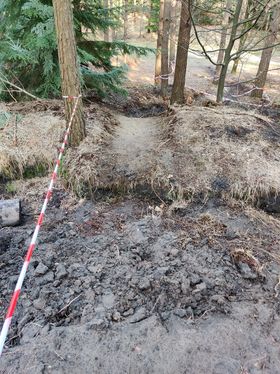
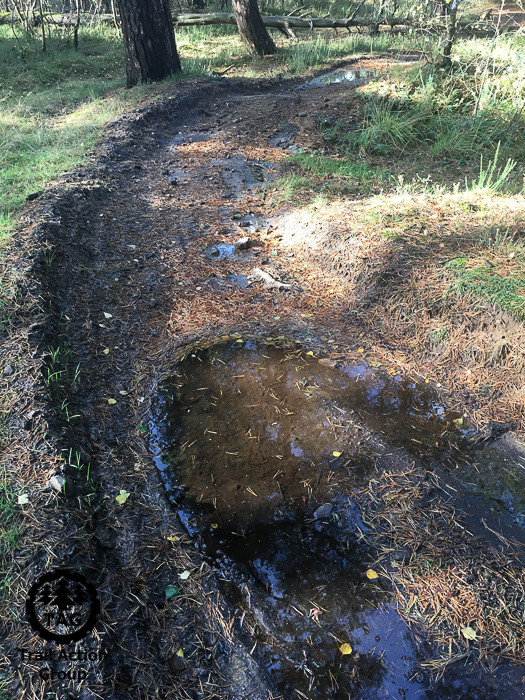
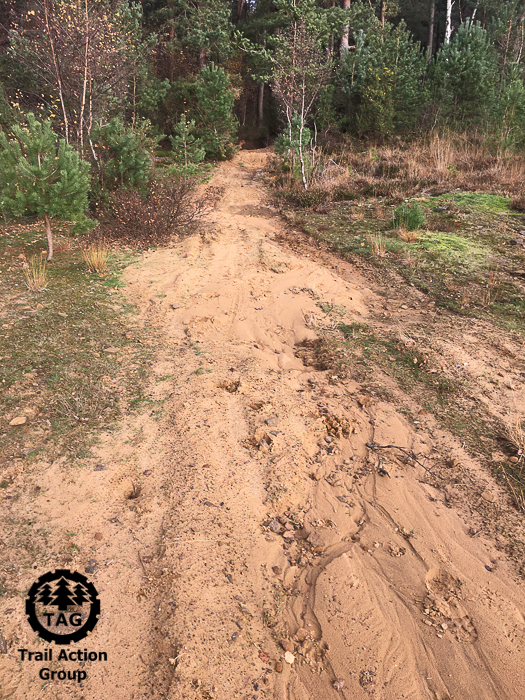
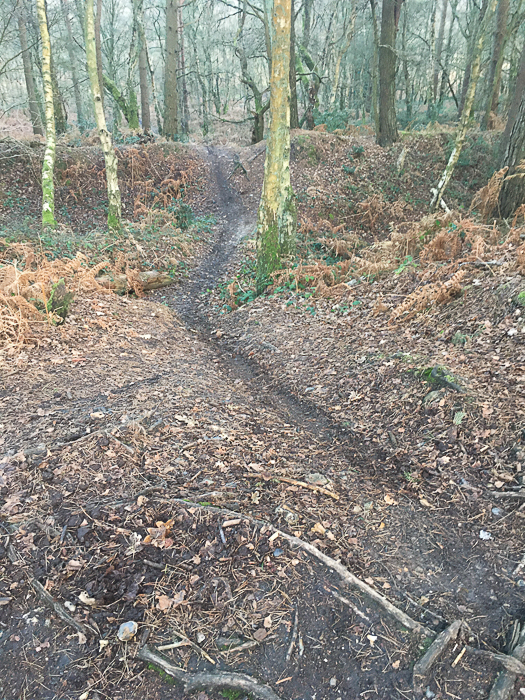
But for all the positives of MTB we will have witnessed a trail that is changing by erosion. Rainfall patterns are changing too and short, heavy downpours will run off faster and use gullies to drain…taking with it loose soil. The steeper the slope and straighter trail the greater the runoff and erosion.

Beacon Hill has been subject to erosion. We fully expect DIO to hold up trail erosion as a good reason to ban every cyclist on every trail…and their track record of using rational evidence to set policy will present a compelling but mostly false narrative leaving the decision makers with a view that Caesars Camp will cease to exist as a hill all thanks to MTB if nothing is done.

So what could we do to counter any emotive or egocentric policy setting?

Here at TAG we always fall back on evidence…and there are ways and means of precisely measuring changes caused by erosion with precise surveying tools (thank you to our friends at One Point Basingstoke), a decent camera or drone and some very clever software.

The technique is called photogrammetry and its used for everything from preserving evidence at serious road collisions to documenting shipwrecks.

So we have selected a couple of trails and scanned them in 3D. Click on the link to take a look:

In 3~6 months we can repeat the process and measure the differences. Early results have hinted at some erosion on one trail but its volume is measured as less than a half a wheel barrow load over 6 months. A small group of riders who care (and who don’t?) would have the trail restored in an hour…

This approach will deliver hard evidence that can then be used for two things:

  • Counter any subjective reasoning proposed by DIO to ban mountain biking
  • Tell us how fast the trails are wearing and plan to repair or divert as required.

Objective evidence is one of the principles of Standards in Public Life. It goes without saying we are more than happy to discuss using the best evidence and mitigation of trail damage with DIO, should they choose to engage.

Causing Harm/Closing Trails

There are a couple of trails that are causing concern and our riding is damaging some precious prehistoric remains.

In July 2021 DIO SE received a report entitled “Scheduled Monument Quinquennial Condition Assessment Surveys, Aldershot Training Area, Hampshire”.

For a 15 page report it mentions mountain biking or cycling no fewer than 17 times, and its not always positive. The main concerns over trail damage are occurring on some of the archeology at Caesars Camp, and we do agree there are some changes needed.

At this point we must point out a few things:

  • Its highly likely public money was spent on this report
  • Lt Col Bishop (Commanding Officer) and staff are likely to have sight of the report
  • It took a Freedom of Information request confirm the report’s existence
  • It took a second request to be provided with a copy

At no point in the 6 months between publication and the FOI request has DIO approached TAG to discuss any concerns regarding MTB damage.

We can draw our own conclusions as to why DIO have sat on the report and continued to bear witness to trail damage. Maybe it’s because one area where walkers and cyclists are blamed for damage is exactly the same area where TSMs like to drive their pickups?

The report author didn’t witness a TSM on patrol, but we have some photos showing vehicle tracks damaging the monument, if needed.

If DIO had raised the report with TAG we could have worked together last year to take action to close the trails and prevent more damage. Three trails that cross the ditch and bank are causing erosion to the 2500 year old fort and to prevent damage all we need do is choose not to ride these short sections of trail.

The vegetation will recover and help stabilise the soil. This will prevent further erosion and limit additional damage.

The green area represents the scheduled monument of Caesars Camp. The red trails show the locations of the trails causing harm. All are causing erosion and we need to let the vegetation recover to protect the 2500 year old fort

So this blog post really is an appeal to everyone asking that we individually and collectively stop riding over the ditch and bank of the Iron Age fort at Caesars Camp. It’s a precious piece of our cultural heritage protected by law (its scheduled by English Heritage) and we can do the responsible thing by applying “Do no harm” principles as much as possible.

What we cannot and must not do is repeat DIO’s “do nothing and watch them fail” approach as this hands good reason to anyone who wants to ban MTB to call for exactly that.

In total the trails doing the harm are a mere 327 metres in length. When compared to what else is available in the area – a whopping 109.88 kms for Long Valley and Caesars Camp combined – then its not a major loss.

We have prepared an overview of the trails:

Tracks and trails at Long Valley and Caesars Camp

Update 13th February – a ride yesterday added another 10kms of trails – total distance is now 118.9kms for both areas.

It’s not quite complete but a very good guide as to what is there. You can download a copy here:

TAG are quietly confident the local community cares about the lands. No one is setting out to deliberately cause harm, but once known and identified we can all do the right thing and the thing right and ride elsewhere letting Caesars Camp ditch and bank heal.