Did You Know – How Much Land?

Over the summer TAG set out to answer a few burning questions:

  • How much casual recreational access space (on MOD land) we have on our doorsteps?
  • Where are the informal tracks and trails?
  • How far do they extend?
  • To what extent do footpaths and bridleways cover the military lands?

Just like the recreational user survey Byelaws Review did in 2020, when the results revealed a minimum of 59,000 hours of recreation per week just from those who bothered to complete the survey, the answers blew TAG away.

The short answers to the questions above could be summarised as massive, everywhere, a huge distance, and not much.

The longer answers, those that actually measure and quantify with some accuracy exactly what we enjoy and is up for review, reveals far more.

“My Lords, you will recollect that last Session I ventured to raise the question of the Surrey commons which the War Office was at that date anxious to acquire and about which there was a great deal of public anxiety both in Surrey and in London.”

Earl Russell – Hansard 22nd February 1928

Working out what our communities have and enjoy today has drawn on a variety of sources including Ordnance Survey supplied data files, open national and local government data, FOI responses, Strava stats, individually gathered GPS data and local knowledge. Its been brought together in professional geospatial mapping software. TAG won’t claim absolute accuracy but the answers are close enough to stand by. Having said that if anyone notices an error then please let us know as corrections, amendments or additions are welcome. TAG see this as a living, breathing and ongoing project.

The Ordnance Survey data arrived after TAG sought answers to explain why the areas around Bordon have lost their “Managed Access” markings on the map. The reason(s) for removal remain a mystery for now.

Love it or hate it, Strava has provided a wealth of visual information and revealing in some detail exactly where the community use the lands for walking, cycling or jogging. TAG are looking to use this data further but for now we rely on the heat maps.

If you want to skip the analysis and jump straight to the numbers then its all here:

TAG have created some PDF maps showing the areas, the trails identified so far, and the off-road feeder and link routes:

“The public shall have free access to the commons in accordance with their legal rights, and free access, subject to appropriate regulations, to the unenclosed lands adjoining the commons which are acquired or are being acquired by the War Department.”


Lord Onslow Under-Secretary of State for War – Hansard 22nd February 1928

Statistics are important but numbers alone don’t tell the whole story.

So just how much, where and what do we have today under the current byelaws?

How much casual access potential is out there?

Lots of Space – How Much?

“Space is big. You just won’t believe how vastly, hugely, mind-bogglingly big it is. I mean, you may think it’s a long way down the road to the chemist’s, but that’s just peanuts to space.”

Douglas Adams

TAG reckon there are approximately 15,300 acres of open space available on the military lands for casual recreation when not in use by the army.

That’s 5 times the size of Heathrow Airport (3032 acres) with the added bonus of being far less noisy and busy. Swinley Forest, home of the blue and red route formal mountain bike trails, is not even close at a mere 2,600 acres and most of which remains (officially) off-limits to bikes.

Put simply, there is a lot of open MOD space and its neatly distributed to give everyone a convenient spot of wild nature within a short walk or bike ride.

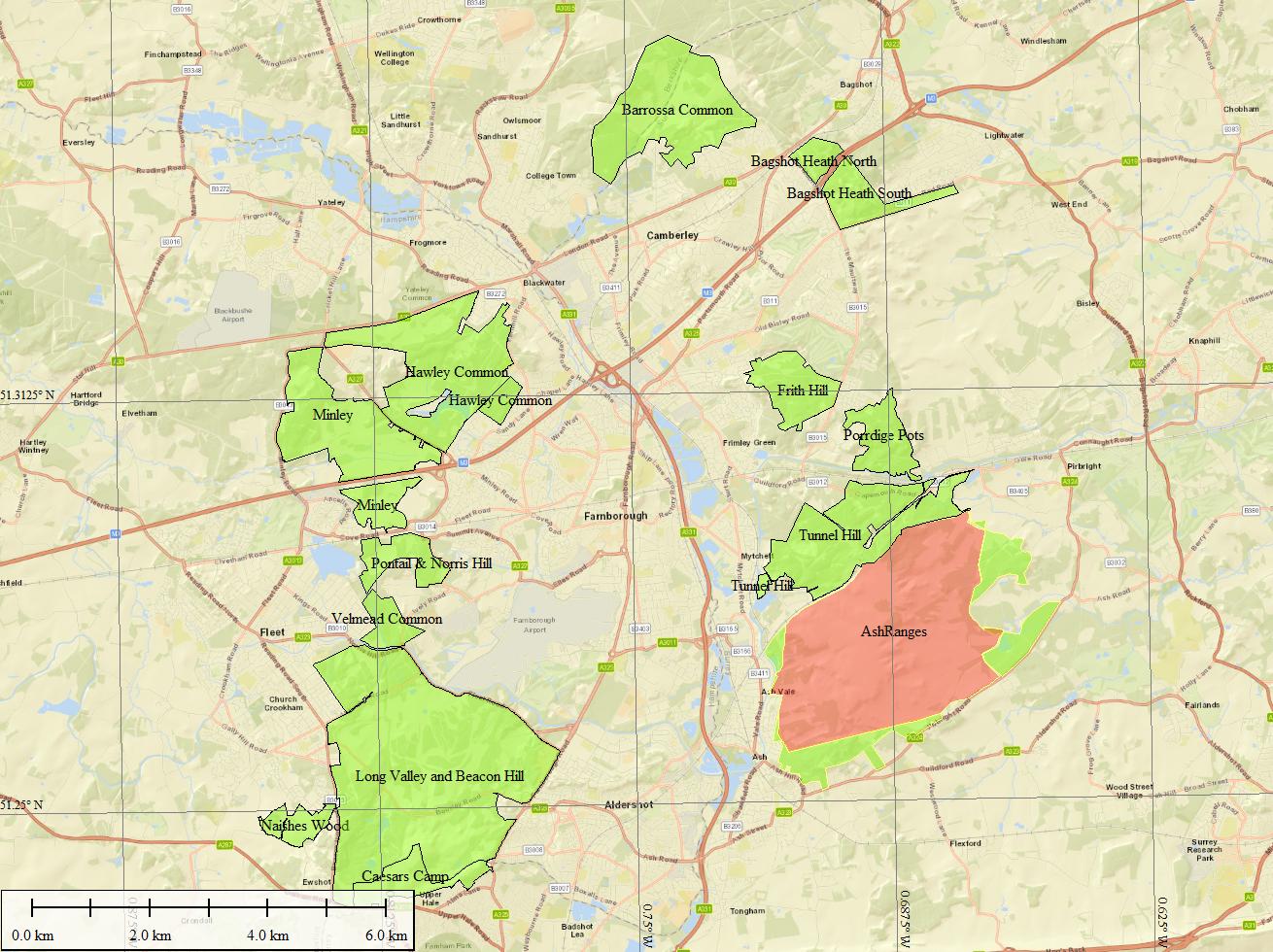
Here’s a map showing the areas covered by the Aldershot and District Military Beylaws and for completeness Hankley Common. Hankley does not come under the Aldershot byelaws but nevertheless it maintains casual access and is local.

Areas in green are dry training (no live fire) and red areas are controlled by red flags and accessible when not in use.

As we will see the cluster of open access lands is critical for the longer distance off-road rides. Here’s a closer look at the Aldershot area:
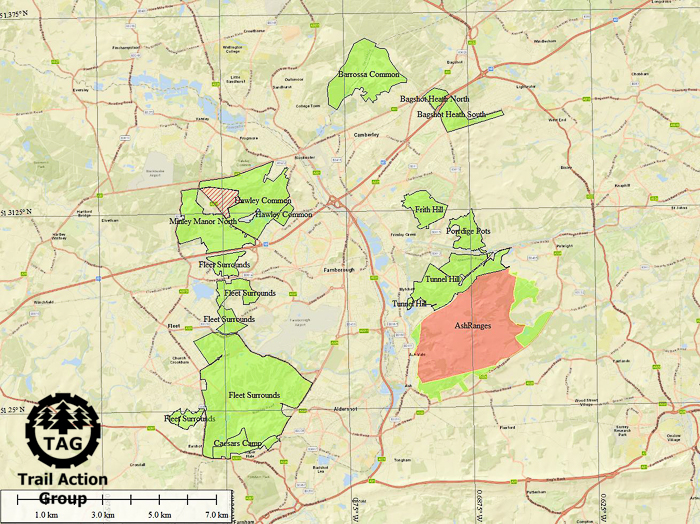
MOD land stretches from Bracknell in the north to Farnham in the south.

The lands to the south are not so extensive but still important:

The lands around Bordon and Hankley Common

Two areas fall inside the South Downs National Park; Longmoor and Weavers Down:

Shown in green the South Downs National Park boundaries enclose Longmoor and Weavers Down

There is a legal framework in which certain areas of land are designated to permit casual access. It is called the Countryside and Rights of Way Act 2000 (aka CROW). In areas designated under the Act the public is granted a right to roam – something very closely aligned with Section 2 of the Aldershot Byelaws – but there are some issues:

  • The designated areas are typically small and fragmented
  • At 12,788 acres they are less than the area of local MOD lands
  • They are poorly located to serve the majority of the community

This map highlights the issue. Green and red areas are MOD casual access and pink areas are designated CROW:
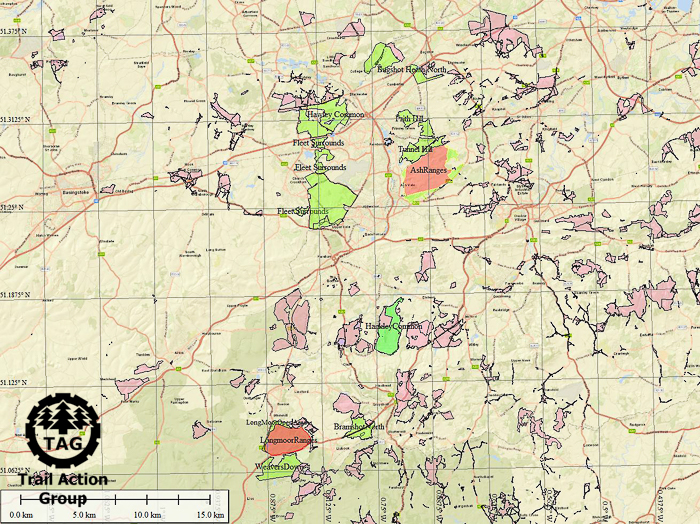
CROW land in pink. Fragmented, small and in the wrong place. Otherwise perfect.

The quality of open space is also worth questioning; one of the CROW areas is Hankley Golf Club course. Try wandering around that space and a few things become apparent; golf balls are hazardous and golfers object to their play being disturbed, and with neatly clipped grass the wild experience is a bit lacking. The golfers have paid for their membership – disturbing their play isn’t really going to help community relations.

However, the bigger problem is location. The major centres of community – Aldershot, Fleet, Farnborough, Camberley and surrounds – are poorly served by CROW yet the sparsely populated area around Frensham and Alice Holt are richly served. The supply isn’t where the demand is.

Do we all want to get into the car and drive to get our wild open space fix? What would the loss of casual access to the MOD lands look like if CROW was the only alternative?

These are questions worth asking and seeking political answers to ahead of the much delayed byelaw review and certainly way before fear-based messaging and locked gates on MOD land becomes normalised and deemed acceptable by the local community.

And let’s be clear; putting up fencing, locking gates and putting up danger signs on a mostly empty piece of land isn’t a prime example of normal behaviour, is it? And there are always better ways to educate than using fear based imagery devoid of supporting evidence.

Rights Of Way

After establishing how much space we have access to TAG then asked how far? How do the lands link up? Where do existing rights of way run and how do long distance routes join in?

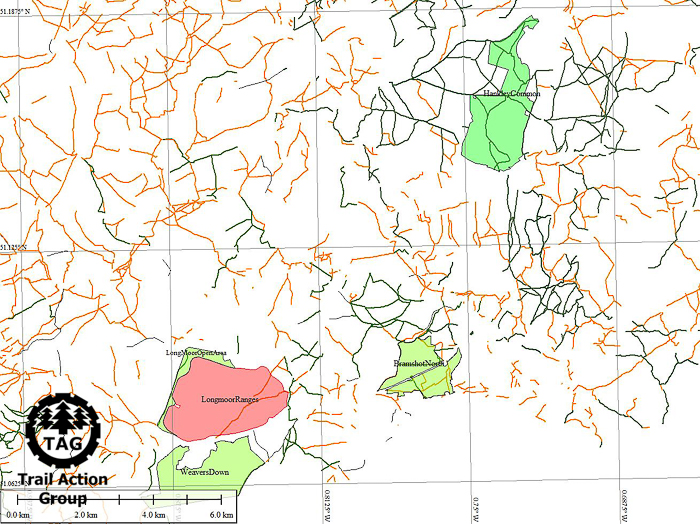
The first check was a look at where the bridleways and foot paths – the rights-of-way – run. Using the mapping tool we can hide the map layer to highlight and visualise the question:

Foot paths and bridleways with the towns and roads removed. Zoomed out it looks great…zoom in and its fragmented and lacks logic. Orange lines are footpaths, green are bridleways. Source; Surrey and Hants rights of way

Zoomed in to each area we can take a closer look:

Measuring exactly how much rights-of-way exist on MOD land revealed:

AreaRight-of-Way (Miles)

Long Valley/Velmead/Caesars Camp
0

Fleet Pond/Norris Hill/Minley South
1.81

Minley Manor
1.37

Hawley Common
6.39

Barrossa Common
2.38

Bagshot Heath North and South
1.48

Porridge Pots and Frith Hill
0.98

Tunnel Hill
1.25

Ash Ranges
5.26

Hankley Common
7.85


Bramshot
5.08

Longmoor
3.79


Weavers Down
0
Total37.65

We have not broken the analysis down further and split bridleways (foot, bike and horse) from footpaths (foot only) but do not expect much better than 50% to be legally usable by bike or pony. Nor does it factor in that there are no restraints on where you can walk.

Which sounds like quite a lot, right? As we will see the short answer is no, not at all.

“Please be assured that the MOD fully understands how essential it is for local communities to have access to open land to carry out recreational and leisure activities, and the Department remains committed to fostering positive relationships with our neighbours.”

The Rt Hon Tobias Ellwood MP – Parliamentary Under-Secretary of State and Minister for Defence Peoples and Veterans – letter to constituent November 2017

With the exception of Hankley Common none of the rights of way really go anywhere useful. Thats not to say they are unused for just for a cycle or walk but it’s all a bit linear and that’s not how folks use the lands, and all require the use of a long distance trail or road to gain access.

Some of the larger areas such as Velmead, Long Valley and Caesars Camp, have no right of way whatsoever and recreation is 100% dependent on Section 2 – casual recreational access when not in use for military training – to enable the space.

Nor are they in the right place. The distribution again favours the lesser populated parts of the counties and isn’t clustered around where they are needed.

There is however some good news. Off-road feeder and link routes exist:

Long distance routes, permissive paths and Sustrans national cycle network

The MOD lands are linked by an extensive and mostly off-road set of permissive or right-of-way routes:

  • Sustrans – National Cycling Network
  • Cycling UK – King Alfred’s Way
  • Basingstoke Canal
  • Blackwater Valley Path
  • Shipwrights Way
  • Greensands Way

All enable safe off-road routes into and through some of some truly stunning, wild countryside and most of that is MOD land. Cycling UK’s King Alfred’s Way is notable and creditworthy as it helped establish a very short (approx 1km) but significant length of permissive path through Caesars Camp/Beacon Hill joining up two bridleways that otherwise required a diversion along busy A roads.

Miles and Miles of Lovely Trails

The next step was to figure out how we all use the lands. Riding the routes and gathering GPS was a sheer pleasure but Strava provided a rich source of where we walk, run and ride.

“I can however assure you that officials have been directed to ensure that existing gates are open for public access to Long Valley when it’s not in use for military training.”

Jeremy Quin MP – Secretary of State for Defence Procurement – letter to constituent July 2019

It was clear from early on the distance was going to be massive. And so it proved with the latest count of 414.4 miles of informal tracks, trails and routes though the MOD lands.

This included rights of way and literally everything else. Yes, it really is 414.4 miles and here’s a breakdown:

AreaTracks and Trails (Miles)

Long Valley/Velmead/Caesars Camp
84.26

Fleet Pond/Norris Hill/Minley South
11.75

Minley Manor
18.35

Hawley Common
31.9

Barrossa Common
21.89

Bagshot Heath North and South
12.04

Porridge Pots and Frith Hill
27.73

Tunnel Hill
21.85

Ash Ranges
66.66

Hankley Common
38.52


Bramshot
8.18

Longmoor
30.65


Weavers Down
31.05
Total414.4

We are not sure if we got ’em all but are confident the total distance is at least 414.4 miles.

The maps reveal the true extent:

Dashed blue lines represent informal tracks and trails in active and current use – Aldershot surrounds with long distance trails included as solid lines

The decision was taken to include the currently closed part of Ash Ranges. All the evidence suggests its still very much in use in spite of its recent closure.

Bordon and surrounds areas with informal tracks and trails in dashed blue. Long distance trails included as solid lines

TAG understand there is some enthusiasm for permissive and linear routes. To put it bluntly there is no appetite or desire to see a concession that compels riders and walkers to stick to a designated path or route. To think behaviour will change with a few signs is likely to end in wasted money, disappointment and alienating the locals. Attempting to measure every transgression off a designated track in the Aldershot area as an incursion will be impossible and won’t create or maintain positive community relations.

Measured and Valued – At Risk

So now we know, or at least have a very good idea of what is at stake. The area open for casual recreational access is massive and the distances open to ride, walk or jog are mind boggling.

And the risks?

Regrettably Long Valley has provided a view of what might happen in the future with putting in fences and locked gates open for high days and holidays. It also draws into sharp focus what happens when politicians engage and set out how things will be. Each incumbent Secretary of State says one thing and the reality served up on the ground is something unrecognisable.

“Additionally, I have been told its the MOD’s intention to include foot gates at various access points and work has been commissioned to address this issue…”

Ranil Jayawardena MP – letter to constituent dated April 2021

A reasonable summary would conclude that the reality of access has fallen very far short of the expectations set.

Politicians and MOD alike patiently explain and recognise the need to maintain these spaces for recreation when not in use – and the government publishes guidelines for healthy lifestyle and policy setters to follow. But the gulf between the stated political assurances to maintain recreational access when not in use and the reality of locked gates and barbed wire topped deterrent fences is more of a Grand Canyon sized chasm than a gap.

TAG could go on and provide more political statements but repetition gets tiring. Eroded trust marks them all down as well-meaning-but-useless. Adding more just burns meaningless words into irrelevant pixels on the screen.

Reinforced by the access issues at Long Valley and Deepcut and loss of 340 acres at Ash Ranges, the deep concerns with the pending byelaws review has been and will remain twofold:

  • Loss of Section 2 and casual recreational access when not in use
  • Loss of access via more fencing and locked gates in other areas

Miracles aside there is no alternative space available and certainly not in the crowded urban regions. The MOD area is extensive and for those who like to ramble on foot, by horse or bike the choice of routes is as close to infinite. No one ever need ride the same route twice in a decade, perhaps a life time if they choose. Fancy an off road ride from Yateley to Weavers Down? A 60 mile off-road ride is there for the taking and there is plenty of choice for the route even if the army are using part of the lands for military training.

What we have is priceless. We humans are part of nature and we are meant to be right there in the wild. The value is immeasurable and whilst the statistics of 15,000 acres and 59,000 hours of use a week are almost mind blowingly high the benefit to the locals in the form of mental and physical health to wider society should firmly and robustly outweigh and silence dissenters.

The lands must remain open for casual access. The normalisation and acceptance of locked gates and barbed wire cannot be permitted or left unchallenged.

The physical and mental health of our local community is depending on it.
DIO and the Duck Test

To quote the late Douglas Adams:

If it looks like a duck, and quacks like a duck, we have at least to consider the possibility that we have a small aquatic bird of the family Anatidae on our hands.

Here at TAG we make extensive use of the duck test and spend time validating or finding the evidence. It makes a lot of sense when holding DIO South East to account and has exposed prejudice, false statements, assertion of powers of arrest and misleading advertising.

For example, until DIO South East started routinely deleting in-use records the validity of the DANGER signs at Long Valley the duck test was applied to the booking on/off records. The duck test proved the DANGER signs published more lies than truth. DIO’s response? Change policy perhaps? Update the signs? No just make sure the evidence is deleted within 48hrs.

The issues TAG expose are not the fault of any military who use the land. Army training is accepted as having priority and primacy.

DIO taking civilian bookings for events are welcomed and seen as a positive thing. It’s great to see the spaces used for military training or public benefit. Those events that foster and strengthen a positive relationship between those who serve and the wider community are particularly welcomed.

Military training is never a concern. What TAG deeply object to is the breadth and depth of misinformation DIO South East are prepared to publish seeking to restrict, limit and discourage causal recreational access at all times irrespective of what is, or most likely is not, going on.

Which is why this blog is going taking a hard look at the claims of DANGER and military training underway on the signs at Long Valley on the 27th of October whilst an orienteering event was underway.

Can an orienteering event really claim to be military training?

And does it qualify as dangerous and likely to place casual recreational users in harm’s way?

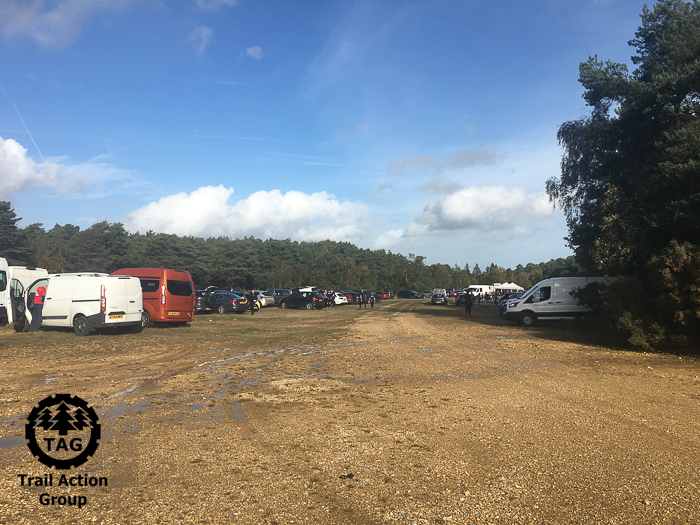
Civilian event underway at Long Valley
Midday 27th October 2022. Civvy event triggers DIO to deploy the DANGER signs. For an orienteering event. Not dangerous and not military training

So, is this a civilian event? Or a military training exercise?

To answer that took a quick trawl on Google and it turned up a useful PDF. A summary would read:

  • There is an entry fee listing military and civilian rates
  • The event is conducted under British Orienteering Rules 2020
  • Toms Food Wagon is in attendance

You can read a redacted copy of the event PDF here. We have highlighted the civvy references to make it easy:

The DANGER signs claim military training. Yet serving military have to pay an entrance fee – and civilians are welcome.

The clincher is how the event is conducted; it’s all under British Orienteering Rules 2020.

British Orienteering is very much a civilian organisation.

Page 2 of the PDF suggests competitors “Have fun and enjoy the woods”. TAG would very much agree with that sentiment. It is regrettable DIO do not see the idea of recreational fun worthy of support. Unless you pay an entrance fee perhaps?

DIO saw nothing wrong in claiming it’s all dangerous and full of important military training when publicly accessible information tells us otherwise.

Just who are DIO trying to fool here?

Spoiler alert, next time you look in the mirror, the face staring back is the person they are seeking to fool.

The report from Long Valley was clear; from the direction and type of vehicle tracks and noise, chainsaw training was underway – at the same time. That takes less than an acre and is always accompanied with signs and tape. The rest of the test track area was empty and unused complete with a fallen tree blocking part of the inner route for the previous week.

It’s not the first time DIO have pulled this stunt so it should not come as a surprise to find DIO have previous form.

Pattern of Behaviour

Orienteering has triggered DANGER signs before:

8th of December 2021 another orienteering event and more DANGER signs preventing causal recreation because, well, because DIO said so

The search for DIO providing misleading information does not stop at Long Valley. DIO don’t hold back when it comes to discouraging casual recreation and this includes the area to the south of us near Bordon known as Weavers Down. This sign went up in October 2020:

DIO duff notice
DIO favoured red on white colour scheme designed to trigger that feeling of danger. Copyright exception – quote and critical review.

At first glance it all looks very official. MOD logos top corner – check. Red font on white background – check. Military motorsport event – check. All very official.

This event was a round of the British Enduro championship where some of the UK top talent were competing for the win. Dangerous? Potentially, but having attended this kind of events as a spectator in the past TAG affirm the organisers take safety very seriously and there are plenty of warning notices and tape marking the course.

The biggest issue with DIO South East here is the claim of the event being military.

The event was run under the Auto Cycle Union (ACU) permit system and open to civilians and serving military alike so just like the orienteering event we have a civilian governing body, in this case the ACU, setting out how the event will be run and has a permit issued to enable it be part of the British championships.

Military? No, not at all. Organised by the military perhaps but run under civvy rules and open to everyone.

But that does not stop DIO. Never let the facts get in the way of the narrative – recreation is unwelcome irrespective of risk.

Stick up the DANGER signs and tell ’em to go away.

To reiterate, TAG are all for seeing the lands used for military training and civilian events like these. It’s good to see the space put to good use when the army are not there.

What TAG object to is the level of misinformation DIO are prepared to publish with the intent of discouraging recreation irrespective of who the organiser or what the actual risk is, and the use of fencing and locked gates to block perfectly legitimate recreation access that the public has enjoyed for over 150 years.

If indeed there is an organiser, bearing witness to empty unused space and a block on casual recreation is morally repugnant and contrary to repeated statements by various Secretary of State for Defence Procurement.

And before we all disappear down the rabbit hole of public liability, these events will need a permit. The terms of that permit transfer the liability to whoever is running the show and it’s up to the organiser to manage the risk. The permits make this clear in their licensing terms and conditions.

Another great example of DIO publishing nonsense.

This sign is at the boundary of Porridge Pots which is an area open and available for casual recreation when not in use for military training.

Recreational access has received support from local MPs and Ministers but DIO keep on trying to discourage the community.

It’s also confirmed by Section 2 of the byelaws which is the only example of factual text printed on the sign. the byelaws statie the land is open to the public when not in use for military training – NO ENTRY?

Like Long Valley it’s just fear based messaging and signage with the singular goal of making us believe there is no public access and to reinforce their narrative.

I am supposed to be here. I belong in this space. I am part of nature.”

So why do DIO go the extra mile to lock the public out? Why publish DANGER signs proclaiming military training when it’s a civilian event?

Honestly? TAG have no idea.

So, we asked DIO directly for a comment.

DIO Speaks

We contacted MOD press office seeking an answer to the following questions:

  • What qualifies a civilian orienteering event as military training requiring DANGER signs in place and what makes it inherently dangerous?
  • How does 7.6hrs of use (October 2020 DIO records) justify 498hrs of DANGER signs and locked gates?
  • How can objective policy – one of the standards in public life – be set using the best evidence if the land use records are deleted within 48hrs?
  • How does the above help DIO meet its commitments and obligations under the Social Value Act 2020?

The Social Value Act 2020 is a relatively new piece of legislation – which is now law. DIO are keen to publish their successes and adherence to the new law elsewhere in the country and TAG have more than a few ideas for DIO SE to add massive value back to society for precisely zero cost to the public purse. TAG would really like them to get in touch.

TAG will be looking at the Act in more detail as DIO is a publicly funded body and for precisely zero cost or change in risk a few simple changes in attitude would deliver much for the local community and improve the MOD / public relationship.

What did MOD have to say?

Regrettably MOD press office failed to respond or comment ahead of publication.

Summary

Maybe the MOD press office realised they were trying to defend a big (dangerous) hole in the ground of DIO South East making and commenting would be the equivalent of reaching for a shovel? TAG is not surprised the request was ignored.

With respect to the orienteering event, we can conclude its hosted by the army but is conducted under civilian rules and is open to anyone.

If it quacks like a duck…the evidence does not support the claim on DIO South East DANGER signs.

As for being dangerous this is a no-brainer unless you are run over by an orienteer.

If it waddles like a duck…another failure to meet the DIO South East DANGER claim.

TAG really do object to being told something is dangerous when the evidence clearly informs anyone with half a brain cell the risks are lower than riding a bike on the road (watch Panorama in the link if you want more information).

If things were really risky as DIO claims, the 59,000 reported hours of recreation per week in the TAG survey of August 2019 should be resulting in daily A&E carnage and personal injury litigation. FOI responses inform us otherwise.

It gets worse. DIO South East remain unwilling to meet ministerial commitments, nor to deliver the April 2021 gates promised by Ranil Jayawardena MP.

Conclusion;

It waddles, swims and quacks.

The signs fail to publish useful or credible information and DIO are treating the community – the people who fund their existence – with contempt.

That sign was put up with public money. The gates are locked and leadership sets policy funded from our taxes. Someone spends time publishing an online calendar that is not matched by the signs. All of this activity costs and the main purpose has all the hallmarks of delivering inconvenience not public safety. TAG believe the primary purpose is protecting DIO liability. Liability that has delivered one claim in five years for injury related to a faulty manhole cover and in no way connected to military training or a civvy event. Skewed risk management?

Telling the truth and using evidence to set policy is well overdue. Everyone is being asked to pay more tax yet we get this service? For this level of contempt?

DIO could easily do better. With minimum cost changes Social Value Act brownie points are there for the taking. TAG would endorse a system of safety that serves everyone.

For now all of us are expected to be and remain DIO’s fools. Judging by the inaction the local politicians are comfortable to see the status quo continue.

Nothing To See – Empty Lands

Regular readers should need no reminding that Long Valley is empty more than used. DIO’s own booking on/off records for October 2020 recorded just 7.6 hours of use while the gates were locked for 495 hours total.

Why is this so important?

Put simply…we humans are supposed to be in nature. We belong there. We are part of it and inseparable from the wild.

For individual and collective positive health exposure to natural environments like Long Valley is a deeply embedded need.

Parts of Long Valley represent some of the finest, wildest areas and are perfect for that natural immersive experience that is necessary to heal the soul and care for the mind. Can you spot the Roe deer?

Since their imposition in 2018 the fence and locked gates have regularly denied the community access to a wild but otherwise empty and unused space.

Fast forward to October 2022 and we are already seeing the same pattern…days of locked gates and no use. The evidence for this claim has been received by TAG in the form of photos recording vehicle tracks…and once again DIO its clear are sticking two fingers up at the community and recreational users.

By now readers shouldn’t need reminding DIO routinely delete records within 48 hours claiming “no business purpose” for their retention. TAG see this as a nothing more than a deliberate action attempting prevent anyone challenging the decisions and policy set for recreational access by Lt Col Dickie Bishop and subordinates…but it does not stop TAG creating records in their own right.

TAG are now in possession of 500+ photos that record what & when stuff happens and they are proving invaluable. A few are shared below to highlight the persistent issues of access at Long Valley.

After reading the tale of an engineered omnishambles that follows and you feel DIO are failing the community then please take a moment to raise concerns with your MP – and we would encourage you to do so – then a link at the bottom of the page will guide you.

Back to the main point; Just what is the problem at Long Valley?

Locked Gates

For the DANGER signs to tell the truth two conditions must exist:

  • Military training must be underway
  • The training must be considered more dangerous than regular “dry” training

It would be reasonable to close the gates too if training was imminent and dangerous.

But locking the gates for civilian events, reccy visits ahead of training, TSMs driving around…map reading exercises…regular dry training…you name it…none of them meet the statement on the signs. Yet DIO will put the DANGER signs up and are comfortable publishing information that is either misleading or an outright lie. The convenience of the timetable is rigidly adhered to, overrides rational thought, remains inflexible and is sacrosanct.

The job of locking and unlocking the gates falls to the TSMs or Landmark. Their vehicle tracks are seen Monday morning and Friday afternoon as they drive between each gate. Often their tyre tracks remain the only significant evidence of use for days. This summer saw very little use of the test track to the point areas now have grass growing on it…yet the DANGER signs were duly raised and the gates locked to the timetable.

Pause for a moment and consider the role of the TSM. TAG wonder if the job had been sold as carrying authority including the powers to arrest recreational users? That must be attractive to the authoritarian types?

How disappointing it must be to find out powers of arrest were revoked 17 years ago.

If the job comprises of driving around to unlock gates and let the unwashed undesirable types such as joggers, dog walkers and heaven forbid the absolute scum lowlife mountain bikers in for mere recreation then the job’s not got the same appeal, has it?

TAG have very little sympathy.

The fences wasted a lot of our money and TAG firmly believes their existence is to support egocentric decision making and access policy.

And as we will see they are not even in the right place, if they could be rationally justified.

Thing is, displaying the DANGER signs and locking gates is now driven by administrative convenience and this is contrary repeated direct instructions from two Ministers of Defence Procurement to keep the area available for casual recreation when not in use. Its also a massive exercise in crying wolf which does nothing to support what DIO claim to be for safety purposes…its just convenience.

It takes a special level of arrogance to ignore a direct instruction from your political masters…but DIO carry on regardless and are have proved immune to any attempts to point out their failings.

The issue of access goes beyond contempt for the community and loss of access. The fence – justified on grounds of driver training – is in the wrong place.

DIO Land Grab

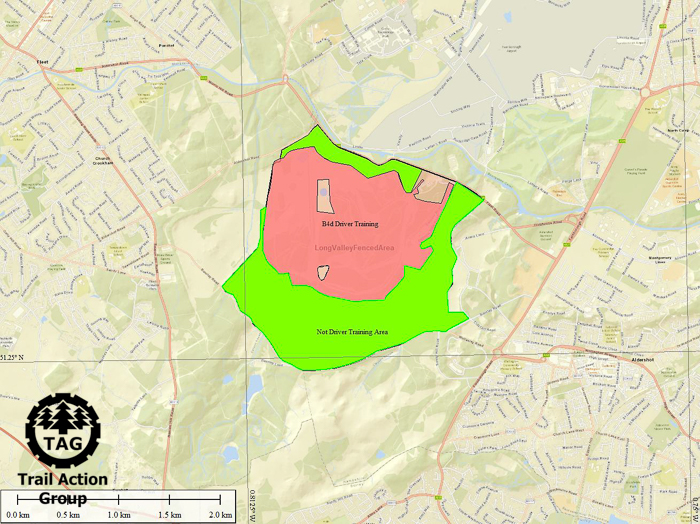
According to DIO Standing Orders for the Aldershot training area only part of Long Valley may be used for driver training. The area is subdivided into two discreet and separate areas B4d and B4e, which is known locally as Eelmoor. Here’s a map showing the full extents of driver training area:

Dark red shape represents the area available/usable for off road driver training – 465 acres total and incudes the Eelmoor tarmac roads.

As a reminder driver training was the justification and there are signs to this day on the fence confirming this. This area covers 465 acres. Now lets compare this are to where the fence runs:

Boundary of fence defined by the red area of 952 acres

Which is a total of 952 acres. Which leaves us with 487 acres of space that is out of bounds to driver training. The green areas highlight the gap between what is driver training and what is not. Visually it represents the loss of space either due to standing orders or a physical impossibility thanks to dense woodland:

Green area is not driver training. Thats 487 acres and much of it dense woodland making driving impossible. Disproportionate use of fencing denies recreation at all times.

B4d and B4e can and are booked separately. On the map B4e accounts for 44.5 acres. However most of this comprises of dense woodland. The actual, workable and usable area is a mere 12.6 acres.

Yup – you guessed correct…a booking in B4e representing just 1.3% of the fenced area triggers closure of the lot. The entire area denied to recreation.

B4e aka Eelmoor. The usable space in dark red is just over 12 acres or 1.3% of the total fenced area. A booking here will trigger closure of the entire area

A dog walker could be a mile away from the 1.3% of used space but thats just too close for comfort by DIO standards. Rational? Reasonable? Based on evidence? Not at all…but nothing stops DIO in their desire to block recreation.

These maps were created from DIO’s own data and the standing orders were obtained via Freedom of Information requests.

The driver training area accounts for just under 50% of the total space…combine this with very limited use and its clear the DANGER signs are publishing irrelevant and misleading information. TAG directly challenges DIO to refute this conclusion with evidence.

TAG will take silence on this matter as acquiescence and confirmation DIO evidence is non-existent.

There is a fence defining the boundary of the driver training area. DIO have let it fall into disrepair and have elected to spend £250,000 on another one to intended to deter everyone from the full 952 acres, not just the portion perceived to be dangerous.

If the real reason is to keep recreational users away from driver training – and we doubt very much it is – then why is the fence excluding the community 24/7 from a vast area of land?

Classic example of DIO over stating risks. Chainsaw training is a regular occurrence in Long Valley and it occupies less than 1 acre with signs up to let recreational users aware. The remaining 951 acres of land are behind the DANGER signs and denied to recreational users. Yet the localised risks remain well managed?

More DIO lies to support egocentric policy decisions? Administrative convenience? Preparing the area for sale? More housing anyone?

The sale of prime land in the South East would help fill a multi-billon pound hole in MOD accounts.

Think MOD won’t sell the training estate?

Think again.

MOD have an ongoing commitment to reduce the estate.

And judging how DIO treat existing wildlife legislation nothing is off-limits.

TAG can see no good reason, nor have DIO ever provided justification to exclude everyone from an area that sees no more danger than “dry” training – the stuff that is conducted elsewhere on the estate – and without the need for a DANGER signs.

Deja Vu – October 2022

TAG have been sent a series of photos taken during the week commencing October 10th.

They reveal a driver training area that is mostly unused with previous vehicle tracks in the soft sand weathered to the point of being erased.

With patient observation and recording there is no need to visit every day. The weathering of vehicle tracks can be used gauge how long has passed since their creation but most important can be directly compared to previous images. Tracking use isn’t precise as booking records but with DIO routinely deleting them TAG can create a record.

Photos now provide a valuable (and only) record of what is going on.

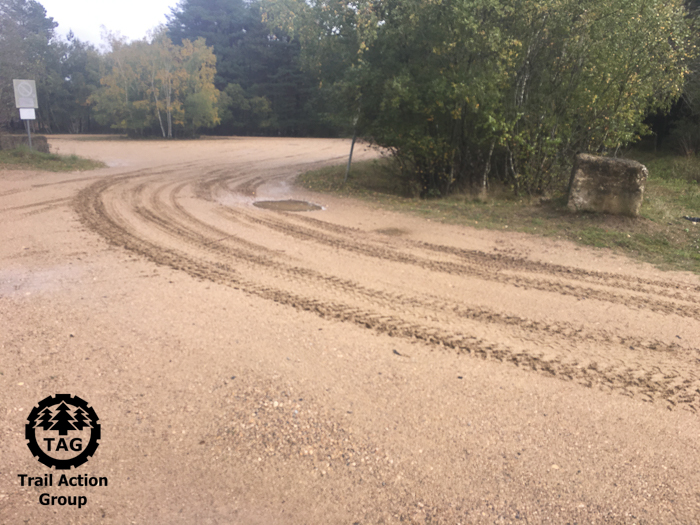
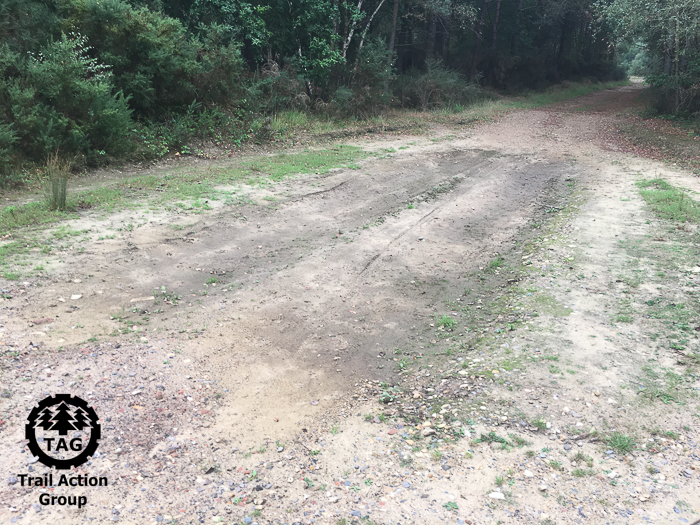
Taken midday Monday 10th this image was taken at the main entrance to the driver training area:

Weathered tracks reveal what is – or in this case is not – happening in Long Valley. Time is needed to erode the tracks to this degree

The area remained unused until at some point prior to AM Thursday:

One vehicle two laps or two vehicles one lap – the first evidence of any use at Long Valley was AM Thursday

Thats three days of zero use…and denied recreational access.

By Sunday the land had seen a little more use. However, the most recent tracks left behind on Sunday and seen below are likely to be a TSM or wildlife pickup and not military training.

Same place on Sunday with the most recent tracks being TSM or similar pickup style tyre treads

A quick ride around the area showed the vehicles were not using the full extent of the available tracks.

Here at TAG we prefer quantitive evidence. A while back the driver training routes was ridden (when not in use!) and recorded:

Driver training routes shown in dark red set against the background of the authorised area. Green represents the area of land inside the fence that is not used for driver training but remains excluded from recreation.

The complete route measures just over 20kms in distance. An average fitness mountain biker would cover that in less than 1hr 30mins. An off road military vehicle is likely to be quicker but the pattern of use over the last two years reveals arrival, one or two laps (not every track every time) and then back to base for tea.

The time Long Valley is used remains a fraction of the time of locked gates and this week’s example is no different to every other week; Minimum use/maximum lockout. The October 2020 example of 7.6 hours of use isn’t unique and continues to this day.

TAG would welcome any challenge from DIO that seeks to disprove our evidence.

Should Long Valley be busy and deserving of locked gates then TAG firmly believe the onus remains on DIO to comprehensively prove it. With evidence. Subject to audit and robust beyond the usual “because we said so”. DIO must clearly demonstrate they are meeting political commitments to make the space available for casual recreation when not in use.

Nothing less will suffice…equally TAG are happy for DIO to remain silent on the matter.

We will take silence as tacit agreement that DIO are unable on balance to prove their case and the DANGER signs really are publishing deliberately misleading information.

Strategic Recreational Asset

TAG bang on a lot about how the use of the locked gates and DANGER signs are being abused. Folks – including Lt Col Bishop and Mark Ludlow (Security and Access) – must be tired of hearing about it.

But the history of failed policy delivering 24/7 lockout is good reason to maintain the tempo and not let the matter rest. In spite of the then Minister for Defence Procurement giving written assurances the area would remain open when not in use for military training this did not happen. In July 2018 DIO locked the gates for a civilian event and walked away, keeping the area locked for months at a time.

DIO had no intention to keep the area open for recreation.

Political assurances were and remain worthless in the face of DIO intransigence.

It took political pressure to secure a commitment from DIO to keep the area open. Even with the commitment in place DIO just ignored the instruction from the Minister before regular access was partially restored with the gates unlocked based on an administrative timetable rather than actual use.

Fast forward to 2020 and it was apparent DIO were still falling short. Their own evidence – in the form of booking on/off records – comprehensively shredded any argument to the contrary.

Then DIO decide to delete the inconvenient truth – the booking on/off records – that should be used to inform and set policy. This is one of the standards in public life. DIO simply ignore the need to function within these expectations.

The current situation is a farce.

DIO carry on locking and unlocking gates perhaps maintaining a fallacious belief the padlocks will work if only people believe just a bit harder. By recording the MTB tracks, dog footprints and jogger trainer marks TAG are confident the DANGER signs are routinely ignored by the local community, who are fully aware the signs are not providing useful or relevant information. For what its worth the popular recreational tracks are away from the driver training routes…

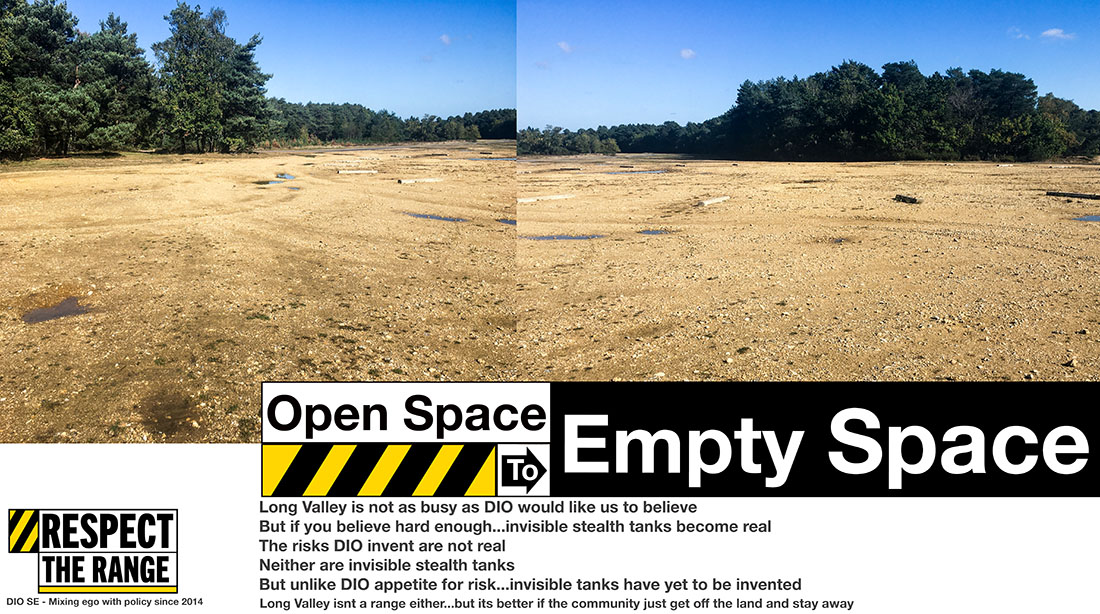
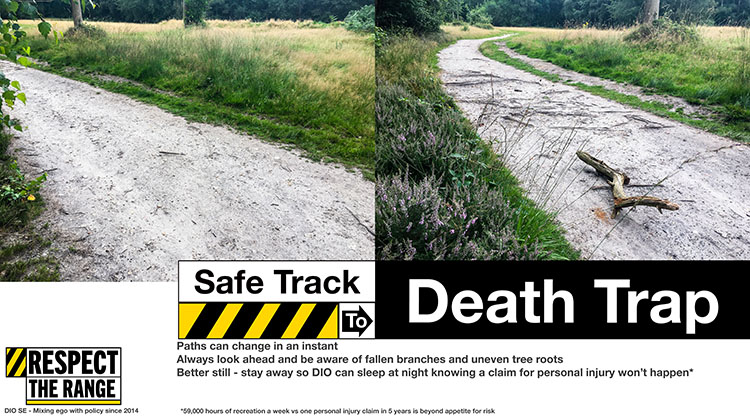
All this misinformation has triggered the TAG satirist creative juices:

Another Respect the Range parody. Long Valley isnt a range but facts and evidence have never stopped DIO publishing nonsense so for satirical reasons it won’t stop TAG either. Copyright material reproduced under parody exception.

The DANGER signs are just a sham. Not worth the scrap value of the boards they are mounted on. The choice of the font and colour scheme is deliberate and is intended to trigger fear…which works until you apply a dose of rational thought and realise its all based on fraud…

Here’s the bottom line:

  • As an open recreational space Long Valley benefits and supports military training

When Caesars Camp and Beacon Hill are used for dry training, including blanks and pyro, Long Valley provides an alternate space to use. Avoiding military training very is important but the fence and locked gates make it harder to do just that. Knowing their enthusiasm for full public exclusion a cynic might think DIO prefer fences to force conflict and see training disrupted…thereby justifying more fences…

  • As an open recreational space Long Valley is a strategic and important space

With links to the Basingstoke Canal to the north, Velmead Common to the west and Caesars Camp and Beacon Hill to the south the are is used for transit as much as exploring. Its an enabler of greater access and more gates enabling access to the 950 acres remains a very important goal.

  • As an open recreational space Long Valley supports the health and wellbeing of the community

Of the 11,000 respondents to the 2020 Byelaws Review survey 4,000 identified Long Valley as an area to use. DIO consistently fail to appreciate the value a cooperative, supportive and welcoming local community represents. Without our cooperation DIO’s goals and aims are worthless and a sensible, rational organisation would be working with the locals not making life hard at every turn.

Try running the show with an uncooperative community who see direct action as a means to achieve the reasonable and rational outcome of preserved and protected casual access

Think it won’t happen?

We would suggest think again. If the National Trust won’t rule it out…or the RSPB…why would anyone think direct action is off limits? TAG are not alone in this thinking with people like Nick Hayes and his excellent book The Trespassers Companion providing food for thought about what comes next.

There are a few simple and inescapable facts that eludes the recreation-is-bad mindset in DIO; humans are very much part of nature and wilderness. We are supposed to be there.

TAG will reason its a human right to exist in nature for we are inseparable. This is recognised by just about every government body except DIO. They stand alone seeking to deny us what Section 2 empowers whilst being funded by the tax revenues the community dumps into their budgets. TAG are now seeing the section of tax handed to DIO as a distinct overhead entitled the “moron premium”…we digress…

DIO function and exist on our cash. DIO require our goodwill and cooperation to deliver their services. Yet we are subject to prejudice, contempt for the laws of the land and are expected to choke on outright lies while Standards in Public Life are disregarded with impunity.

There is a wealth of good evidence to confirm a mentally and physically healthy society is more economically active than unhealthy versions. Demand for health services falls and tax revenues rise. With deterrent fences, closed areas and locked gates DIO are literally killing all- slowly and imperceptibly – the goose that lays the golden tax eggs.

And no one seems to have made that link. Or if they have its a matter of DIO policy to ignore the long term outcomes.

  • The success of closing Long Valley will embolden DIO to block casual recreational access

Recreational access is not protected.

DIO remain at liberty and beyond accountability to fence any and all areas they choose.

Think Caesars Camp will remain open? TAG suggests think again.

The fact humans have been using the space for at least 6000 years will count for nothing if DIO decide to pull the plug, fund a fence, install the DANGER flip boards deliver another example of Long Valley “managed access”.

Still not convinced?

Mark Ludlow (Security and Access) is on record saying the areas need greater protection for the habitat and the new byelaws would reflect this “need”.

TAG views this as utter nonsense and is an example of how simply an emboldened DIO will decide what areas are deemed to be off-limits for any human who is not anointed and blessed by written permission. Contrast that to how Middlewick Ranges have been treated…nothing DIO say ever makes joined up sense to the rational thinking types. And knowing how certain groups are blessed by DIO with a named contact…whilst cyclists are treated one up from dog mess…we can guess who might get permission and who won’t be on the guest list.

Sweet chestnuts on the Eelmoor road. Anyone driving this way will have squashed em…but no one has. There is a wealth of evidence to support non-use and a dire lack of anything to convince anyone DIO has truth on its side

The idea of using military byelaws to protect habitats makes even less sense when the current raft of protections – SSSI/SPA/Wildlife and Countryside Act plus the existing byelaws – are taken into account.

The desire to protect is sound but DIO are dropping the “solution” to their “problem” on at the feet of casual recreation. The habitat is precious and yes ground nesting birds are indeed worthy of protection but industrialised agriculture and its practices have done more harm than recreational users have to Nightjar chances of success. Yet DIO blame the local community and resolve to ban us instead challenging the real culprits.

DIO will use any and all means to justify their desire to limit or remove casual recreation…its all a fallacy.

Just what part of the existing laws fail to protect the wildlife?

The easy answer…the smokescreen of habitat protection would empower DIO to remove the very thing they despise and resent whilst presenting a charade of being a caring and nurturing organisation. Goodbye casual recreational access.

Which is the very thing we cherish, treasure and value – because we humans are part of wild nature and an active balanced life means immersion in a natural environment is inseparable from the what it means to be a healthy, net positive contributing member of society.

We pay their wages. They work for us. Its time the local community is recognised and treated with respect.

The Way Forward

The current situation isnt sustainable. The holes in the fence and recreational tracks demonstrate the deterrent isn’t working.

Until the Seven Principles of Public Life are amended to include egocentric policy and publishing misleading information, changes must be made to how DIO function and engage with the local community. Changing policy on Long Valley opening times is a step towards that goal.

TAG recognise the need for the army to train. What we struggle with is seeing DIO act as if the community does not exist and their collective and individual failure to use evidence to set policy. We also recognise there might be a lag between closing and start of training and similar when training ceases…but we are not talking a few hours lost…its hundreds of hours per month and thousands over a year. We can never get this time back but the time for change and a better future is now.

TAG sees several options:

  • Do nothing

This option is worthy of consideration for a fleeting moment…but like a bad budget its best dropped as it will not deliver an outcome. The status quo cannot be allowed to continue as it serves no one.

  • Remove the fence

This option would be expensive but TAG will wager a large group of willing volunteers would pull it down and dispose of its carcass at zero cost to the taxpayer. Judging by the number of holes in the fence there is plenty of talent out there and it won’t take long…this option is TAG preferred.

  • Unlock gates and reword signs

The default setting for gates should be unlocked. The DANGER signs replaced with CAUTION signs and more information advising where driver training occurs. The principle must be to inform and educate not revert to fear mongering and scare tactics. Gates may be locked but only when the type of training really is dangerous…apply the lessons and principles of respected range red flags and garner some respect for the system of safety.

Of the three TAG consider the sensible and pragmatic compromise of lowering the warnings to rational levels – advising CAUTION – and supplying sensible information to help recreational users let the army do their thing as the best way forward. The gates can remain unlocked and the TSMs are free to concentrate on other matters. If training gets really gnarly then the decision to lock gates can be taken…but the risks to trigger that will require a rational mindset.

This one is a win-win for all.

So to conclude we will ask everyone to do two things:

Firstly, when you enter the lands adopt a simple mindset;

“I am supposed to be here. I belong in this space. I am part of nature.”

We are supposed to be in nature, to feel the wild and suck in the benefits being in open wild space brings. By taking on a positive mindset we start to remove the barriers and fences others have imposed on our free will. We are, in effect, turning every visit into a small, unmeasured but very personal protest at loss of access.

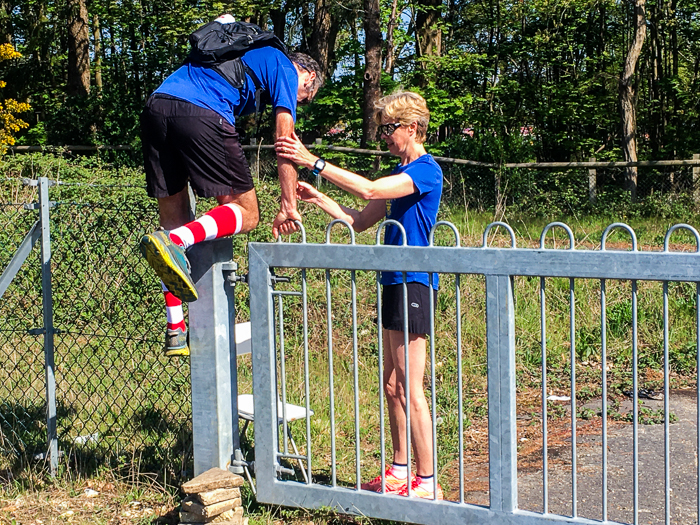
Having practiced it, stepping over the fence no longer triggers the negative emotions DIO seek to induce with their barbed wire and faux DANGER signs.

Secondly, if you feel suitably aggrieved please feel free to contact your MP and raise your concerns. Encourage them to seek the sensible compromise – include a link to this blog if it helps articulate the issues. Make it clear casual recreational access – including Long Valley – is not something to be removed or blocked by unelected unaccountable remote desk bound civil servants. Remind them of the extreme value of casual recreational access to the wild spaces and ask what provisions they plan for increased healthcare costs if restrictions continue or expand.

Here’s the link:

https://www.writetothem.com

Nothing To See Part III

“I can arrest you now”

The loss of liberty and freedoms should never be taken lightly. There are very good reasons why public officials cannot go around arresting people and detaining them without good reason.

At the comedic end Not The Nine O’Clock News and Constable Savage’s made-up charges like “walking in a loud shirt in a built up area…” poke fun but in reality the experience is something entirely different.

Arrest and loss of liberty – when the state removes freedom of its citizens – is no laughing matter. For this reason powers are limited to those with recognised authority. The Human Rights Act recognises this and protects the right to liberty. Article five makes it clear in the second sentence:

No one shall be deprived of his liberty save in the following cases and in accordance with a procedure prescribed by law

And before we sit back, relax and think the state will apply the law correctly and with diligence we should consider a few salient points:

  • Successive governments have cut back legal aid so a tiny minority qualify
  • The courts service has been underfunded for a very long time
  • Criminal barristers have either left the profession or are (at time of writing) on strike

The bottom line; anyone thinking the system and the state will magically function in their favour and work hard to avoid committing a miscarriage of justice is deluded and needs to sit up and smell the coffee. Anyone sucked into this system must be prepared to pay out of their own pocket for a legal defence and wait years for justice to be served.

And don’t think for one moment your legal costs if acquitted will be met in full. The government has capped them and you will be out of pocket for any mistake made.

Enter this system at your peril and expect to spend your own money even if the state screws up.

Not convinced? Have a read of the Secret Barrister’s work at exposing just how well [sic] the legal system is running.

Don’t think it will apply to you?

It won’t…until it does when a Training Area Safety Marshall (TSM) decides “riding a bicycle off the main track” fits the profile of a criminal. Without legal certainty who knows what stunt DIO will pull next?

We should expect anyone using the words “I can arrest you now” is using a procedure prescribed by law.

Which, as we will see, is not how Defence Infrastructure Omnishambles choose to operate or bother to educate their TSMs.

Background

Way back in May 2021 a TSM – we are not obliged to anonymise public facing officials but for now lets call him Mr A – made the threat of arrest.

A smartly dressed Mr A thought anyone in uniform can enforce the Aldershot Byelaws. Section 7 of the Aldershot byelaws makes it clear who is empowered (and wearing a uniform isn’t listed) but compared to a threat of arrest it’s a minor faux pas.

When pressed Mr A confirmed no one – certainly no one legally qualified – had offered him any guidance on exactly what powers a TSM might hold. Like us, he “…had just read the byelaws. Since no one has told me.”.

Nevertheless Mr A felt empowered to assert he held powers beyond a mere civilian.

Let’s pause for a moment and consider; DIO are sending TSMs into the community without legal advice.

Really? No training? No legal advice?

Mr A was confident in his interpretation to threaten arrest. You can read the entire transcript of the conversation in the link below.

Our favourite part is where Mr A thinks it reasonable to close 340 acres of access because illiterate people are unable to read a sign warning of a steep drop. Even when the sign has a picture visually indicating what would happen to those who cannot read – falling in a hole. A big hole that is difficult to miss. On account of it being…obvious. We digress…

Ash Ranges. Lethal when the flags are up. Death trap even when empty according to DIO.

So the burning questions:

Does a TSM hold the powers of arrest?

Is Section 7 of the Aldershot byelaws still valid?

You would expect senior DIO staff are aware of current legislation relating to powers of arrest so that TSMs would receive appropriate training on their legal powers before letting them loose to threaten arrest.

Instead it took public fundraising to pay for qualified legal advice to spell out exactly what the law says. But before we dig deeper into the powers (or not) of arrest a TSM holds, lets pause for a moment and see how DIO treat another part of the laws of the land – copyright.

Photos? Help Yourself!

The skill and diligent approach by DIO when considering “public engagement and community relations” [sic] is fully expressed at their decision to close an area of Ash Ranges. Shambolic would be a fair summary.

We won’t dwell on how DIO decided to pull off a stunt, blaming everything from, in succession, COVID to vandalism (only those with corporate knowledge could understand costs) or those pesky holes in the ground ready to trap the illiterate, but we will dip briefly into how DIO staff treat the local community photographers.

DIO published a Powerpoint presentation “explaining” why the ranges really must be closed.

Included were some really nice photos showing vandalism. Damaged fences and a broken gates are serious but it was a shame the damage was about a mile away from the closed area and the gate had been hit by an army truck but never mind, the locals had to be excluded and why let facts get in the way of the narrative.

Also included was a photo taken by a member of the public. It had been shared on social medial and DIO had helped themselves to it. DIO published the photo to suit their agenda.

The photographer is vehemently opposed to the closure of the ranges. To see their photo being exploited by DIO bolstering their lies was galling to put it mildly.

Just like R.E.M, The Rolling Stones, Adele and Elton John object to Donald Trump using their music at his rallies.

The Long Valley signs…rarely telling the truth. DIO expect us to follow the byelaws but are unable or unwilling to do likewise.

Now it may come as a shocker, but copyright law means the photographer is the sole individual who can decide what their photo is used for and it’s an exclusive right. But that didn’t stop DIO.

They helped themselves and published it anyway.

So, DIO staff had don’t think the laws of the land apply to them, went ahead anyway and breached the rights of the photographer.

Such is the contempt and lack of basic knowledge of how the laws work.

Legal Advice

Friends and fellow campaigners Save Our Spaces wanted to know how the laws of the land applied to DIO and if the powers of arrest were valid. The local community backed a fundraiser and sought legal advice – which is not cheap.

With respect to the powers of arrest held by a TSM as empowered by the Aldershot byelaws the legal counsel’s view was crystal clear:

Schedule 7 para 38 of the Serious Organised Crime and Police Act 2005 removed the powers of arrest [For a TSM].

MoD police and serving officers or NCOs remain empowered to arrest – but not the TSMs.

So a TSM threatening arrest under the Aldershot byelaws is – and we will not labour the point – working beyond their powers:

Mr A – a holder of public office – was asserting powers that have removed from the Aldershot and District Byelaws.

Instead of sourcing qualified legal advice DIO let the TSM read and interpret the laws how they saw fit.

Far better to continue to threaten arrest and scare the recreational users off the lands – it suits DIO narrative- even if the powers were defunct in 2005.

The Ombudsman Speaks

You may think a public office holder claiming to hold powers that don’t exist is ripe for a complaint. It hardly fits into the Standards in Public Life and even better Mr A was in full agreement. From the transcript:

“Yeah, I agree that we should be held to account, whatever because we are a public office.”

There was an overlap between the Ombudsman starting to look at the case and the arrival of legal advice. Initially the Ombudsman found nothing wrong. Then, when we started to challenge this the Ombudsman pressed for the legal reasoning before reconsidering:

“…if you can explain exactly what part of the 2005 Act revoked these powers, we will be happy to look again.”

Note how at every turn it’s down to the community or individuals to prove the state is wrong?

So we shared legal counsel’s view.

Even though it was 30 days beyond the Ombudsman’s time limit they pressed for it – double standards when compared to other evidence we turned up in other complaints.

In the end we were going absolutely nowhere and were given this reason:

“I am afraid this has been declined. This is because the related injustice does not meet our threshold for review, which requires far more serious injustice.”

Yes folks, you read it correctly. A holder of public office can go around claiming to hold powers that no longer exist.

Compliance with Article 5 of the HRA is set aside. The Ombudsman goes on to explain:

“While I am sure you experienced annoyance at the conversation, this would not meet our threshold for review.”

TAG really have no more to add, apart from a reminder how a false arrest and entry into the criminal justice system will be more than just “annoyance”.

Clearly the Ombudsman has a different set of values but being threatened with arrest by someone who has no such power should have no place in a civil, liberal and open democracy. Maybe TSM really stands for Training Stazi Marshal?

TAG are left wondering what TSM behaviour or indeed how low DIO standards have to drop before anyone really cares?

Summary

We do have some sympathy with Mr A. Trying to sidestep responsibility and blaming others further up the chain with I’m just doing my job won’t work as it fails to meet Principles of Public Life (1.7 – Leadership). Anyone trying the blame game and pinning it on the boss isn’t really hitting the standards.

But in this case TAG see the incident as a symptom of ineffective leadership. The broad failure to train staff reveals the shambolic nature of higher management and casuality towards a responsibility to deliver an effective, legally compliant minimum level of service.

In the profit and loss world of commercial survival the directors of a company would be failing to discharge their duties…shareholders see profits slip. DIO are under no such pressure – when money arrives, budgets are allocated and DIO spend cash like sailors on shore leave and the matter of trained and qualified staff is of little concern. Except it’s our money being spent and DIO are wasting it whilst simultaneously failing to deliver a service we should expect. TAG firmly believe the buck stops firmly on the desks of Lt Col Bishop and Mark Ludlow.

Between TAG and Save Our Spaces we have compiled a DIO statement fact checking sheet. Its running at 56 statements – not including the absolute gem “I can arrest you now”. There are quotes from a wide range of DIO staff all guilty of making things up and it’s a target rich environment when it comes to demonstrating a wide range of mendacious attitudes, opinions and ego based “policy”.

We will be dipping into it over the next few months, revealing what was said by whom and picking it apart for validity.

The contempt for legal compliance takes things to an unbelievable level of omnishambles as DIO staff have demonstrated a less than compliant attitude to the laws of the land. From helping themselves to copyright protected material and publishing it to suit their own agenda to letting unqualified or trained staff interpret and threaten the law.

Never mind the Human Rights Act works to prevent wrongful arrest, or showing contempt to the local community and publishing an image to suit a decision taken without good grounding or evidence. If it assists Disruptive Intransigent Omnishambles to achieve the goal of restricting access and disrupting causal recreational access then its all fair game.

But it gets worse. Consider this;

DIO are charged with authoring the replacement byelaws. If DIO cannot follow the basics and get the current laws right what level of competence can we expect with the new set?

When DIO refuses to respect the local community and steal an image, or threaten arrest when there is no procedure prescribed by law, should we really expect anything less than draconian recreational restrictions?

TAG firmly believe DIO should cease publishing intellectually insulting adverts, stop deleting records and drop the idea of trying bad faith engagement. Training their staff in the law would be another positive step and installing the gates at Long Valley as promised by MP Ranil Jayawardena would undo some of the damage DIO have inflicted in community relations.

What is well overdue and absolutely required is a move towards rational, evidence based policy that has both a sense of purpose and – above all – proportionality.

TAG can and will support that.

Respect…What Exactly?

In our last blog we said the next one would be all about TSM threats of arrest but when the facts change so do our plans.

Some of you may be receiving Respect the Range sponsored and highly targeted ads on social media. Things like these:

Now, we are all for education and public engagement but in true TAG style we have some questions about accuracy, and just how relevant they really are to the Aldershot Training Area.

So we have applied a bit of fact-checking. It should come as no surprise to regular readers the message Defence Infrastructure Omnishambles is pushing is not quite as truthful as it should be. We will pick apart the claims, visuals and overall message in turn.

Aldershot is used for live-fire training

A quick visual analysis of the lands surrounding Aldershot reveal the extend of live fire and those used for “dry” training (everything from map reading to blank rounds). Here’s a handy map:

Map showing areas open to the public. Red represents live-fire and green shows areas used for dry training

The ONLY area used for live-fire (the area highlighted in red) which, when the red flags are down and not displayed is open to the public, is Ash Ranges and the whole area is red flagged when in use. The red flag system is generally believed to be understood and recognised by the local community. There are other ranges, but with no public access at all they are irrelevant to any ad campaign.

The red flag danger area at Ash measures 2412.5 acres and has its own byelaws in place to enable shooting and restrict public access when in use for firing.

The green areas represent the rest of the casual access lands around Aldershot where training may take place but cannot involve live-fire. 

The green areas measure a total of 8480.67 acres total.

The campaign message is not selective in the assertion of risk or harm from live-fire. There is no reference to red flags. The representation of danger applying equally across all training areas is simply not true. 

A reasonable conclusion is that the majority of the Aldershot training area is not used for live-fire and are not ranges. The advert is therefore misleading.

Visual References

The imagery used in one advert presents a Chinook helicopter and Warrior armoured vehicle. We do see Chinook helicopters in the area but they are typically seen at 500′ transiting from or to RAF Odiham. Its the proximity of the airfield that raises their presence here, not the fact we have military lands close by.

The Warrior armoured fighting vehicle is a different kettle of fish. 

Heavy, and with limited driver visibility, tracked armour vehicles can be dangerous. Avoiding them is a very good idea. They only use the main firetracks and are also very noisy.

But the adverts ignore the simple fact the Aldershot Standing Orders do not permit the use of tracked vehicles with the exception of Bagshot Heath South, or with the express permission of the Senior Training Safety Officer (STSO).

Ironically, Bagshot Heath South has more public rights of way crossing the training area than anywhere else but only accounts for 239.3 acres.

DIO will be fully aware of the Aldershot Training Area Standing Orders because they wrote them. It might be possible to ask how often the STSO grants tracked use but with DIO’s record keeping standards it is not geared around evidence based policy (delete em 48hrs after creating them) raising a Freedom of Information request is likely to waste time than achieve anything.

The campaign message visuals is lost in Aldershot. Tracked armour remain largely irrelevant and the imagery used, and specifically the inclusion of a Warrior armoured vehicle and low flying Chinook, is not representative of what actually happens.

The message is irrelevant to the community.

Check the Training Times Now

On one hand, the published firing times for Ash Ranges are reasonably accurate.

On the other hand, the published training times published for Long Valley are shambolic and in the realm of fantasy. The open/closed times on the website not representative of actual use and are – for the most part – untrue.

We won’t labour the point here, but the 7.6 hours of use from 495 hours of locked gates is proof enough.

Sponsored by MOD

Taxpayer money is being spent to raise awareness, This is a good thing. 

But the wider concern is the Aldershot Byelaws and specifically Section 2 (Recreational access when not in use) has been completely overlooked.

This is likely to be due to a cock up or ignorance, or the expression of a desire to see the Aldershot lands treated as the rest of the training estate where access is either not permitted or is strictly controlled.

The concept of casual recreational access when not in use is likely to be causing DIO concerns. It does not fit with their desire to control and manage to the nth degree. For a guide, the experiences of Long Valley highlight the preferred method of “when we say so or can be bothered…or feel like it” rather than when not in use.

The latter is supported by not only the current byelaws but the Minister for Defence Procurement. The fear of recreational users coming to harm is not supported by the statistics; at least 59,000 hours of recreation per week with just one example of DIO being sued for personal injury in 5 years.

And before DIO start to claim success about making things “safe”, that period covers time before fences went up and access was restricted. The personal injury claim had nothing to do with military training. It was triggered by a dodgy manhole cover.

The concept of casual access when not in use is not exclusive to Aldershot. The entire training estate in Scotland reverts to open access when not in use thanks to a right to roam.

DIO can cope with casual access when forced to but it takes political will and desire…something we have found to be lacking around here.

With such a negative “get off our lands” message TAG can only presume the new byelaws are intended to deliver just that.

Summary

The adverts are intended to, and should, convey an important message. But the imagery and overall message is just not based on facts or balanced evidence. The presentation of danger and the deliberate inclusion of scary things like tanks might work elsewhere but Aldershot really does not bear witness to such training.

After years of fear-based negative messaging – COVID being a recent event – it might just be time to find an alternative method? It’s just possible the local community will not take too much heed from being told they might get run over by tank or hit by missile on the grounds that tanks and missiles are not deployed or fired here. 

TAG reckons a positive step would be for Difficult Intransigent Omnishambles to pause insulting the intelligence of the local community. Sometimes doing nothing really is the best option, with the bonus of saving a pile of taxpayer money in these cash strapped times.

The fear-based off-target message is a cheap, tired method. The local community really deserve better, especially when it’s our money being spent. For a moment TAG considered taking the adverts to the Advertising Standards people but then remembered our experience with the Ombudsman ended in a waste of time, but at least we are not alone with the FT raising concerns with other regulatory bodies.

To be fair its not all bad.

The important message remains absolutely sound. Live-fire and training in general by the armed forces must remain respected and is absolutely necessary to ensure our troops are trained to the highest standards.

The TAG code of conduct remains clear, relevant and easy to understand. If the training ops change, so will our guide but for now the absence of tracked vehicles and missiles indicates it is still fit for purpose.

The positive recognition that the Aldershot military lands are a shared space is welcomed, embraced and worth repeating back every time DIO try to restrict recreation. Their acknowledgement people ride bicycles (on singletrack) is good news and another nail in the under the byelaws cycling is not permitted statement DIO repeat ad nauseam whenever the question of MTB is raised and it’s another good reason to grant cyclists legal certainty.

Overall the ad campaign is a clumsy attempt to scare people off the lands and to soften up a community for a more restrictive set of byelaws. The locals who use the lands are likely to see this message for what it is – a waste of time and money – and the outcome will be no overall change in the way, and when they use the lands. The public accounts will record a spend of taxpayer money on something that could have been achieved at far less cost by simply engaging in good faith with the public and groups like TAG.

Finally, the adverts triggered a creative avalanche of ideas around parody. Here’s two examples:

TAG will be taking a look how DIO understands the laws around copyright in a forthcoming blog (spoiler alert – they didn’t understand them) but before anyone heads off down the rabbit hole suggesting TAG are failing to respect copyright and starts asking for removal please read Section 30A of the Copyright Designs and Patents Act before getting in touch.

Parody is easy when DIO offer up a target rich environment. We will return to the matters of arrest, legal compliance and how a new DIO CEO might be an improvement of the previous incumbent.

Nothing To See Part II

There is a scene in the classic film Apocalypse Now TAG feel drawn to.

The lead character, Captain Willard, has met his nemesis Colonel Kurtz. Kurtz was out of control running a renegade army deep in the jungles of Cambodia and conducting a war on his own terms. The conversation goes like this:

Kurtz: “Are my methods unsound?”

Willard: “I don’t see any method at all, sir”

A rather bloated and rambling Marlon Brando played Kurtz. TAG wonder if DIO are using the film and character as a guide to public engagement with cyclists? The Standards of Public Office are clearly defined yet when it comes to cyclists DIO appear to pay them only lip service and the Ombudsman finds no fault despite the evidence TAG has supplied.

TAG see a selective and discriminatory approach to recreational user groups with some are given the red carpet treatment and VIP access whilst cyclists are at best treated as a social leper. Here’s a good example from the government website covering access to the training estate:

We welcome external groups such as ramblers and horse societies to contact our access forum and make agreed arrangements about access in advance of any activity taking place. More information can be found on our Access Forum.

Here’s a list of the known user groups DIO recognise in some form or other, and how their otherwise illegal activities prohibited under the byelaws are permitted:

Group or PracticeForbidden ByEnabled By
EquestriansSection 4(2) – ride a horseSection 8(3) DIO authorised permit
Commercial Dog WalkersSection 4(3) – engage in trade or businessSection 8(3) DIO authorised permit
Ramblers Section 4(5) – Assemble and walk as a groupSection 8(3) written permission

The first two – horse riding and walking dogs for money – operate on a commercial basis. This is not something TAG would wish to see applied to casual recreation. TAG firmly believes the beneficial mental and physical health benefits for individuals and society at large far outweigh any fee DIO might earn.

But the Ramblers are a different kettle of fish as there is no commercial agreement and there is very good reasons to think DIO are applying discrimination and have as yet been unable to provide TAG with their justification.

But first, lets have a look at how the Ramblers got where they are and what service they receive today from DIO.

Red Carpet for Ramblers

The earliest record of the Ramblers engagement with DIO is the Ramblers own website. Back in 2014, at the same time as the now infamous Crookham Parish Hall meeting (where DIO announced cycling bans were in force) the Ramblers were also seen as troublemakers and were being stopped by DIO staff for walking in a group.

Yes, thats right. For the crime of walking in a group.

The Ramblers – just like cyclists – pushed back and didn’t back down. The outcome was written authorisation signed by Mark Ludlow agreeing that Ramblers could indeed walk en masse and not be bothered by DIO staff unless there was military training going on.

You can read the document for yourself here:

Contrast this to how cyclists were graded just one step above dog mess with the mantra “cycling is against the byelaws” repeated at every opportunity.

A proper DIO welcome for cyclists – there is a belief within DIO this is acceptable

Why didn’t cyclists get the same treatment?

We think there are two primary reasons.

Firstly, the Ramblers are better organised and their national body is not only vocal but is prepared to challenge and are able to draw upon legal advice to pressure DIO. Note how the liability for any deviation from the planned route is gently pushed onto DIO – the legal implications are clear and it’s a smart move, moving the risk of DIO instructions back onto DIO.

Secondly, TAG firmly believes there is a negative bias against cycling and cyclists at work in DIO.

Lacking any evidence to suggest cycling must be banned, whilst granting the Ramblers rights under Section 8(3) (written permission) suggests individual and collective bias is setting public policy.

Otherwise, cyclists would be treated equally or presented with compelling evidence to justify DIO’s actions. The absence of evidence and bias towards others sends a clear signal.

Or does it?

When you consider the results from the TAG 2020 Byelaws survey we know 42% of the 11,000 respondents identified cycling as an activity yet only 160 equestrian permits were issued over a two year period.

The alternative explanation for DIO’s lack of engagement might be more straightforward;

Cycling and cyclists cause statistically irrelevant levels of harm or risk. As such DIO have no need to spend time trying to manage the activity.

But this does not fully explain or justify why a Section 8(3) authorisation for cyclists remains elusive.

Either way it’s difficult to see how DIO’s behaviour is compatible with the Seven Principles in Public Life.

But as we shall see neither local politicians nor the Parliamentary Ombudsman really cares too much so DIO are free to carry on.

The application of bias starts to take us into the Human Rights Act. Article 14 is a right to not be discriminated against yet DIO are doing just that and importantly without good reason supported by any evidence TAG are aware of.

The Human Rights angle is interesting – look beyond the tabloid outrage of how the HRA prevents the deportation of mass murderers because they had a pet dog or how it means prisoners can demand hardcore porn in their cells and none are true but are great examples of how to gaslight a society. Nor does it mean we are being run by Europe. Dig deeper and and you find the Act helps wronged citizens hold the powerful to account.

Until you are snagged into it the HRA really doesn’t seem important but when you are, it is of course.

TAG would wager organisations like DIO do not appreciate the HRA. It’s a tool to hold the State and its operatives to account so why would they?

We will return to the HRA in later posts as we think DIO are now playing a waiting game but that’s for a later post.

The cosy relationship with Ramblers doesn’t stop with Mark Ludlow (Security and Access) writing a nice letter and delivering up Section 8(3) authorisation. The Ramblers now have a personal contact within DIO to liaise with and a link from the introductory web page takes anyone clicking it to a form that sends a message directly to Dean Howard (Security and Access) to inform him directly of any planned walk.

Red carpet for Ramblers…fences and discouragement for the rest of us

And before we go down the rabbit hole of “cyclists are hostile to DIO so who can blame them?” let’s remember both groups started from the same position – a ban – but the group with a strong national body representation found a supportive attitude within DIO and is likely how the Ramblers end up in a different place.

If there was ever good evidence of bias and discrimination against one group, then it’s right here. TAG don’t begrudge or object to how DIO have chosen to engage with the Ramblers – its a sound idea – but we do strongly object to discrimination.

TAG thought a clear example of bias combined with a deliberate policy to deny legal clarity would have been enough for the Ombudsman to find fault in DIO’s behaviour.

How wrong we were.

The Complaint

In 2019 TAG raised two complaints against DIO.

One was centred around the locked gates at Long Valley (yes, that old chestnut) and one challenged the behaviour of DIO representatives. DIO staff had considered it acceptable to tell children riding their bikes at Beacon Hill to “f**k off”.

Both complaints were accepted and a meeting between TAG and DIO was held. Assurances were given Long Valley would be opened (it wasn’t – until more pressure was applied) and the staff were given guidance on what is not acceptable. TAG were assured swearing a minors was treated as unacceptable.

As the meeting broke up TAG Chair was guided into Mark Ludlow’s office. What followed was a chat that made it clear cycling was allowed and cyclists were not to be hounded and harassed. The meeting was verbal and no minutes were being taken – this rang an alarm bell. However, this was a game changer and shift in policy, one to be applauded and publicised so TAG did just that and the result was the 2019 agreement.

Prior to publication an email chain was established to provide a written record for both TAG and DIO documenting the agreement with the intent to publish and what the content was to say.

Since publication DIO have raised no concerns, objections or complaints. Nor have changes, amendments or removal been sought.

TAG are very confident the content and intent of what DIO said with respect to cyclists and cycling on the lands has been faithfully reproduced in the published agreement.

Everyone was happy. TAG were delighted with the announcement and the local community were free to use the lands responsibly and ride a bicycle.

Then we started to get reports from cyclists that TSMs (Training Safety Marshalls) had been stopping them and insisting they stick to the main tracks or fire roads.

Main track terminating in a permanently locked gate – there are three tracks that split from this path and if you are on foot you may walk to a gate at the end of one of them. Cyclists are expected to turn around.

This wasn’t mentioned during the conversation in Mark Ludlow’s office. Nor had it been part of the email exchange and final published agreement. Nor have DIO sought changes or amendments. Naturally we would have given any evidence-based and backed change or amendment a fair hearing but no contact was made and no changes were asked for.

The byelaws are silent on the matter of recreational users sticking to main track so DIO bias is kicking off again and the main tracks are the one place where vehicles are regularly driven so compelling cyclists to ride this space makes little sense.

This started to raise concerns. Where would DIO stop? Over time would the TSMs revert and start repeating ad nauseam “Cycling is banned under the byelaws“? (The answer to that is “yes” but we will save that one for another post). When challenged the TSMs simply responded “Don’t know anything about that”.

Which says a lot about internal comms within DIO.

The best engagement. TSM driving past without bothering a cyclist.

A FOI request revealed DIO SE had no written policy with regards to cycling on the military lands. By now DIO had already wasted volunteer time soliciting reports that have been ignored and the relationship had, from an initial hope of a more collaborative approach, reverted back to deep suspicion and mistrust.

So we thought it was worth involving the Ombudsman. After all, if civil servants go back on an agreement or policy then is beyond compliance to standards in public life.

The Ombudsman’s View

The Ombudsman’s opening response was:

Under section 4(2) of the Byelaws cycling is prohibited except for on the main roads. 

Which isn’t strictly true as the byelaws actually say something different. But it set the scene and what followed focussed on how DIO had issued clear communication and guidance.

The Ombudsman considered the email chain and concluded there was no agreement to permit cycling, and that:

The advice from DIO was clear, accurate and relevant and therefore in line with our Principles of Good Administration

The issues of discrimination was raised and Article 14 of the HRA cited but the Ombudsman declined to consider these points as they were “new”.

When dealing with new evidence the Ombudsman was less than consistent. As we shall see in the next post qualified legal advice was needed to consider one complaint and this disclosed after the original submission – but before anyone gets too excited the Ombudsman then ignored it even when it shows a TSM stepped deep into legally questionable territory.

Further evidence was refused including the video as created for and published by DIO. The one where the mountain biker is seen cycling on everything but a fire road.

Yes, that is right. A mountain biker in a DIO video cycling on single track.

The video itself features Challenger II tanks firing on the move, Warrior armoured vehicles rumbling around and mortar rounds being fired – none of which are relevant here in Aldershot. The claim that training can occur “24 hours a day 7 days a week” is now impossible to prove or disprove since DIO delete the records after 48 hours. There is the usual statement claiming DIO welcome recreational access “when it is safe” but as proved at Long Valley it really means when they can be bothered to unlock the gates.

The only real surprise is a that a TSM does not appear in the video and tell them off. You can watch it here:

DIO Video Showing Where MTB Can Ride

So, we have a PR video showing cyclists off road, on single track, when in reality the TSMs tell cyclists to stick to the fire roads with the Ombudsman declining to review the evidence and insisting TAG have clear comms.

As communication with the Ombudsman drew to a close TAG were contacted and were pointed to the link on the Farnham Ramblers website. A second one was found on Portsmouth Ramblers and a third on the main Ramblers website.

There seemed little point in sharing this with the Ombudsman…as there really is nothing to see.

Summary

To a policy writer the idea of sticking to fire roads and main tracks might seem sound.

However, there is no definition of what a main track is and so can be anything DIO want it to be to suit the conversation. There are instances where a track terminates in a locked gate or fence. Fire roads terminate and split into a series of smaller trails. Sometimes main tracks just get smaller and smaller or disappear and lose definition. Do cyclists shrug and turn around?

Where do we go from here? The main track ends so sticking to it becomes impossible. Practical implications are not really within DIO’s remit.

Then there is a question of how much track there is. Long Valley and Caesars Camp/Beacon Hill have just 26kms of stone road (as defined on DIO’s own internal maps) yet there is over 120kms of tracks & trails ready to ride. Do cyclists really ignore the best bits just because DIO don’t like us?

If you are stopped by a TSM our advice on what to do remains unchanged but TAG would add, if possible record the encounter. Important; Make it clear you are making a recording. There may be objection but there are no powers to compel anyone to cease recording or filming an interaction with a public official or representative.

On more than one occasion DIO staff have been found to make false or misleading statements and a recording removes any doubt around what was said. This should help hold them to account, particularly if there are examples telling folk to f**k off again.

Remember, not even the police are exempt from being filmed by the public as they go about their work. The TSMs probably won’t like it and may object. But there is nothing in the byelaws and TAG are unaware of any law that prevents the recording of a public office holder in the execution of their duties.

Just as the Ramblers do, make sure you get a name and make a note of of the request. If anything goes amiss on the DIO diverted route then liability for any incident may well lie at their feet.

If it’s good for Ramblers, it’s good for cyclists too.

So sticking to the main tracks sounds great on paper. In practice its unworkable and those on foot are under no obligation to stick to a main track. But the problem goes further than just being told to ride a specific route.

Consider this; All other Section 8(3) user groups – the equestrians, commercial dog walkers and the Ramblers – have one thing in common; legal certainty.

Cyclists have no such thing and riding with friends makes matters worse. Yes, organising a group ride really does break two byelaws and not just one. As the TSM berates you and your fellow cyclists, just remember the Ramblers can point to Mark Ludlow’s letter as you listen to the tired insistence about sticking to the main tracks.

Legal uncertainty may suit DIO but the lack of clarity is not the basis for a liberal, open and functioning democracy.

If it’s good for Ramblers, it’s good for cyclists too.

Combined with DIO’s approach of “it’s whatever we say is” fire road interpretation, and limited and mixed message, ineffective communication skills, we have all the elements of a public policy that is both shambolic and not based on sound practice, irrespective of the decisions – egocentric or zero impact – applied to decline positive engagement and legal certainty.

In Apocalypse Now Willard didn’t see any methods and neither does TAG. DIO appear free to make it up as they go along using prejudice as a guide with discrimination the inevitable outcome.

TAG hoped for a more firm and sound legal basis securing Section 8(3) authorisation for cyclists and the local community. For now it has eluded us.

For now TAG will continue to maintain our code of conduct and publication of the statement on cycling.

Unless and until DIO seek changes we will stand by the record. TAG will also take every opportunity to remind them the Respect the Range video is a persistent and visual record covering where cycling is deemed acceptable…and that includes the tracks and trails that wind though the lands.

A gate would restore long-standing access marked on the 1888 Ordnance Survey map. Local MP Ranil Jayawardena is on record saying more were coming. DIO have ignored that and now Mr Jayawardena is ignoring constituents asking “where are the gates?”.

Legal certainty is needed yet no one in leadership is prepared to grasp the DIO nettle. The Ombudsman can set aside their own policy documents. Local MPs are unable to get simple things like a few gates installed and have all the appearances of taking everything DIO says without question or challenge.

If it’s good for Ramblers, it’s good for us too.

This mess is likely to continue as long as the public collectively and individually permit it.

In the next instalment we will see how DIO CEO spends their time, how leadership standards ripple down so DIO staff can really overstep the mark and ignore the laws of the land, why recording a TSM encounter is priceless, and how the Ombudsman refused to consider the complaint until qualified legal advice was shared. And then completely disregard it and the logical outcome.

Nothing To See Here – Part I

Recently TAG raised several complaints against DIO and their behaviour with the Parliamentary Ombudsman, which covered:

  • Wasting volunteer time
  • Ignoring the 2019 agreement permitting cycling
  • Ignoring a ministerial directive to keep Long Valley open when not in use
  • DIO staff asserting that they hold powers of arrest when the law says otherwise

Submitted evidence included written records of meetings and emails to and from DIO staff. Qualified legal advice was shared. Anecdotes or unsubstantiated claims were set aside with hard evidence as the sole basis of the complaints.

The test of evidence isn’t beyond doubt but based on balance so the hurdle to clear and to secure an upheld complaint the hurdle is fairly low. Yet the Ombudsman has found DIO staff have absolutely nothing to answer for.

Written evidence was accepted on one complaint when it supported DIO’s view, yet the very same evidence was set aside and DIO collective memory failure held to dismiss a second. Records intended to eliminate memory failure were carefully read and agreed:

It seems clear that DIO were aware that TAG would draw up the two proposals, but these do not appear to have been formally commissioned by DIO

Yet goes on to say;

We would not be able to say, even on the balance of probabilities, what should have happened or what actually happened, and therefore we cannot reach a robust decision about this part of the complaint. 

Even when the meeting notes, circulated to all attendees, agreed a report into trail digging mitigation was sought. And duly delivered to Mark Ludlow. And subsequently ignored – which was the crux of the complaint.

It will come as no surprise to find TAG does not agree with the outcome. Regrettably the expense and complexity of a Judicial Review prevents us taking the issue further.

So we thought the best step is share the outcomes with the local community, and pose a few questions such as;

Is this how we should expect civil servants to act and behave?

Or;

As tax payers and voters should we expect and seek higher standards?

We are not going to pick into the finer details of each complaint but we will share the background and outcomes to the significant three that directly impact the community:

  • The Ministerial directive to keep Long Valley open when not in use
  • The 2019 agreement permitting cycling
  • Training Area Safety Marshals and the power of arrest

So with that in mind here is the first of three blog posts with this one exploring how a Minister using the word directed isn’t a directive, and why the Ombudsman thinks 7.6 hours of use from 495 hours of locked gates is fine.

Training underway…or on balance, probably not. Booking records inform us the signs lie more than the the truth

Complaint 1 – Access at Long Valley

Back in July 2020 the Minister for Defence Procurement, Jeremy Quin MP, wrote a letter making it clear Long Valley was to be kept open for recreation when not in use. Here are his exact words:

“I can assure you officials have been directed to ensure that existing gates are open for public access to Long Valley when it is not in use for military training”. indeed there are copies of this on some of the gates.

And you can download a copy of the letter here:

As an aside, note how DIO blame a developer for a fence erected on their land blocking access and the fence was justified to stop anti-social activities. A FOI revealed no records of fly tipping or quad biking in the area.

Also note how Air Accident Investigation employees asked for a new fence. A FOI seeking confirmation revealed the Air Accident people held no records of communication with DIO.

DIO will blame anyone and anything but themselves when a new fence appears.

Back to the complaint. The key points here are:

  • Its a Minister giving a very clear instruction
  • The word directed has been used

So based on that we have a ministerial directive. A clear, unequivocal instruction given by the elected head of the department – aka the Minister – telling DIO exactly what to do. There is no wriggle room, get out clause or ambiguity permitting DIO to get out of doing as they are told.

This was the basis of our complaint; That Lt Col Bishop and staff at DIO South East were guilty of ignoring a ministerial directive.

With plenty of examples of extended lockout – including the 7.6 hour poster child from October 2020 – we thought it would be a straightforward decision.

What the Ombudsman Says

The first surprise was a Minister using the word directed was not a ministerial directive. According to the Ombudsman:

“…despite the language used, this is not a formal Ministerial Direction…”

But goes on to acknowledge “The minister is telling MOD staff what to do.” yet the gates remain locked for extended periods. This was the crux of the complaint with DIO-authored evidence to support the complaint.

The second surprise was how much emphasis the Ombudsman placed on the byelaws, which was not anticipated as the complaints really focused on individual behaviour rather than how they stacked up legally – although we will discuss how DIO continue to apply a dead law in a forthcoming blog.

The locked vs in use analysis based on the booking on/off records carried no direct comment and the Ombudsman laboured the point how much extra work and planning opening the gates imposed on DIO and how having a timetable helped everyone – particularly DIO – plan.

It should be noted that all the extra work and planning involving opening the gates only happened AFTER the fencing was put up by DIO removing 150 years of free public access when not in use for military training.

Except the timetable is never updated to reflect reality and leaving the locked gates in place is perfectly acceptable – in spite of what the Minister instructed – because:

“…the MOD chooses to grant permissive access to Long Valley and has committed to doing so while training is not in place.”

Still waters on an unused test track lie clear. Try driving a truck through the puddle and see the difference.

Which is not true.

Committing to keep an area open when not in use is different to actually meeting that goal. And the Minister’s words are overruled by the primacy of DIO having discretion. Why bother with a minister if DIO can carry on regardless?

The primary concern is the misuse of what should be a system of safety. The DANGER signs really must communicate the truth, and that has been in short supply ever since their first use in 2018 to close the area for a civilian event.

Summary

By locking the gates to align with a calendar that remains unaltered for a month at a time DIO continue to shut the area when not in use. Any claim of “always in use” can be set aside by applying Hitchen’s Razor since DIO now routinely delete records within 48hrs.

TAG raised the concern of record deletion with the Ombudsman. There was no appetite to take this evidence into account, even though record deletion breaches the published principles organisations are expected to meet.

The number of footprints, dog paw prints and cycle tracks left imprinted in the sand tells us more recreation than driver training happens. The local community recognises the DANGER signs and uses them more as a guideline than an absolute instruction.

Perhaps the best we could expect was this observation from the Ombudsman:

…in practice DIO does not appear to amend the timetable once it is published.

And this:

we accept that training may not always take place. 

No kidding Sherlock!

The evidence was there for all to read. In black and white and DIO’s own inked records. We are at a loss to understand why this has not been accepted and acted upon.

Does it matter the DANGER signs lie?

So what if no one reads the website and carries on climbing the gates whilst keeping an eye out for any training?

Not really, no. DIO will have no idea how much recreation goes on and think the gates work. They are on record claiming that they are a success. Which, if DIO’s intention is to exclude recreation and sell the land in the long term is perfect.

But it really does matter.

TAG would love to see an honest and robust system of safety adopted. When we see an end to a culture that accepts 116.8 hours of use versus 2,215 hours locked as reasonable and proportionate and uses evidence to set policy we will be the first to support it.

Regrettably that will not happen as long as DIO and their behaviour, including the deletion of records, remains unaccountable.

A functioning democracy relies on honesty, truth and transparency and in this regard the local community deserves far better value than is currently being delivered.

We see little hope of political accountability and whilst many fine words have been expressed by the local MPs the measured outcomes are slim to nil, including the gates Ranil Jayawardena promised were coming in April 2021.

Finally, we would urge any and all volunteer groups engaged with DIO South East to proceed with extreme caution. Irrespective of the Ombudsman’s position TAG remain firm in the view a report into trail building mitigation was solicited, and subsequently ignored.

Our advice: Be wary of DIO staff asking for volunteer input only to suffer amnesia later.

From our perspective, its all more evidence of bad faith engagement. Which is contrary to what Brigadier Jonathan Bartholomew claims…and we quote:

“It’s key that we work together to share these spaces with respect and consideration.”

On that we can very much agree.

Regrettably DIO South East has no intention of following what we understood to be a direct order. Fat chance it will deliver change and respect for the local community…After all, if they can ignore a Minister what hope does a mere Brigadier have?

Next week; How DIO can treat one user group so differently and yet bend over backwards to help other user groups and how that introduces a beginners guide to the Human Rights Act.

De-Ranged!

The summer is here and here at TAG we are taking advantage of the great weather to enjoy the wild open spaces of the military lands.

The recent focus on standards in public life has finally delivered a result. Locally and on a similar theme TAG have few updates worth sharing and – surprise surprise – DIO’s latest antics just might trigger a WTH shake of the head.

Summer Reading

We often struggle to articulate why access to the training estate is so important. Why are the rambling nature and informality of the tracks and trails so vital to mental and physical health?

For words and inspiration we need look no further than Nick Hayes‘ excellent work The Book of Trespass.

We would urge everyone to read this book, for it explains why the urge to be in nature, what makes a fence such and affront and offensive, how the powerful manipulate and seek to suppress and remove access…but above all what makes access to the military lands part of us and us very much part of the space.

We humans have been part of the landscape for thousands of years. Neolithic flints at Caesars Camp attest to this and exclusion is a very recent and unwelcome intrusion.

Neolithic flint found at Caesars Camp carrying the unmistakable mark of human presence between 4000 and 6000 years ago

At its basic level, with no gym fees or expensive equipment, recreational access really should be open and available to all. No matter the colour, creed or disposable income everyone can take part. The wider win delivered by casual access is reduced costs for physical and mental health intervention – a healthy society. We have yet to see any evidence DIO take these factors – our welfare – into consideration.

All good booksellers should have a copy of Nick’s book – such as this one.

No, its not a sponsored link or commission based plug to read Nick’s book…just a good idea if you have ever wondered why DIO are so obsessed with control and why the local community places a high value on casual access.

TAG & Private Eye

Known for its cutting journalism and exposing the corrupt, Private Eye have cast their critical gaze over DIO South East and their behaviour towards recreational access.

The article entitled De-ranged* can be found on page 48 in issue 1574 and covers a wide ranging (no pun intended) set of issues triggered by DIO, and points out this isn’t the first time the Eye has covered their antics. Issue 1555 of the Eye featured the efforts of Save our Spaces to reinstate access at Ash Ranges.

The latest article is worth a read, but only if your blood pressure can tolerate tales of empty threats, deletion of records to hide the truth, and the simple fact Long Valley really isn’t as busy as the signs claim.

The article mentions a email TAG received from an unnamed DIO email account, asking that we cease naming DIO staff, such as the commanding officer Lt Col Dickie Bishop, and only use generic titles claiming GDPR rules as good reason.

We checked with the ICO.

Junior officials can expect not to be named. However, senior staff – and those who set and make policy decisions – should expect to be held accountable. Which is exactly the principle we adhere to.

Until DIO can point to the legislation that backs up their claim the email can sit in the “crude attempt at censorship” bucket. DIO have repeatedly claimed the ICO are looking into a complaint against TAG…but at time of writing they have refused to provide the case reference number, in spite of being asked for it multiple times.

No doubt DIO would prefer to see everything working their way and trying to suppress dissent would help greatly. TAG are in good company. Private Eye have shared the name of who sits at the top of the mess DIO SE. We wonder if Private Eye will be subject to a similar complaints?

There is every chance more material will be heading to Private Eye very soon…we hope to make DIO and staff a regular feature.

*TAG adored the title…so we shamelessly copied it.

Uncomfortable Truth? Delete It!

For a long time the DANGER signs at Long Valley have been telling lies. TAG have proved this by obtaining the booking on/off records and comparing them to the number of hours the gates were locked.

You can read the full story here.

The October 2020 records are…outstanding. From 498 hours of lockout the area was in use for a mere 7.6 hours. This qualifies as a WTH head shake moment…but that is exactly what DIO’s own records said.

Before we go on its important to remind everyone there is such a thing as Standards in Public Life. There are seven of them (see Seven Principles of Public Life) and one is objectivity. We repeat it here:

Holders of public office must act and take decisions impartially, fairly and on merit, using the best evidence and without discrimination or bias.

From our latest FOI request we now know booking on/off records are deleted within 48 hours of their creation.

Yes, thats right…DIO are deleting records to prevent anyone from using them… to either inform objective policy (little chance of that happening in DIO) or permit objective and very reasonable criticism of their behaviour (every chance of TAG doing just that).

DIO records prove there is little chance of this sign telling the truth and conveying relevant information. The risks of a warning sign “crying wolf” are recognised but without political accountability DIO remain free to carry on ignoring a direct instruction to keep the area open when not in use

Another WTH head shake moment? We think so.

MoD’s own policy document (JSP375) indicates records should be kept for 3 years. Clearly DIO seem to think it doesn’t apply to them.

However, there is an extensive set of records that we can rely on.

TAG have been amassing a photographic record and there are nearly 400 images that capture the lack of use within Long Valley.

On their own the images simply record changes in the land and vehicle movements, or lack thereof. Collectively the date/time/location data highlight a pattern of inactivity and empty unused space.

With DIO deleting their own records we are confident TAG hold the sole example of a decent set of evidence, but we would always welcome any and all contributions.

From the bike tyre marks and dog walker footprints we know the local community are ignoring the signs – perfectly reasonable considering they lie more often than not – and the walk/ride could be put to wider benefit if a few photos were taken.

We will treat all contributions anonymously, so if you can help please get in touch via our Facebook Page.

Finally, should a TSM (Training Area Safety Marshall) attempt to prevent photography do ask for their name, and even better record the encounter…any attempt to restrict photography or recording by a TSM would be a very interesting discussion and hearing their reasons would be important.

Important; Make it clear you are making a recording of the encounter. There may be objection but there are no powers to compel anyone to cease recording or filming an interaction with a public official or representative

Political Inaction

The local MPs have been generous in their support and kind words regarding recreational access to the lands. The MP for North East Hampshire – Ranil Jayawardena – took the lack of gates at Long Valley seriously (see Where Are The Gates) and wrote to constituents assuring more access was planned.

That was in April 2021. Its now June 2022 and no new gates have been installed.

TAG followed this up with a FOI to see the gate plans and DIO confirmed no such plans exist.

This is hardly surprising given DIO’s track record on ignoring political direction.

We know of several local constituents who have gone back to Mr Jayawardena, asking for an update on the gates. Regrettably at time of writing there has been no reply forthcoming. No wonder the community is resorting to informal access restoration.

When deciding what gets their attention politicians will undoubtedly factor in what wins votes and contrary to the kind words access to the military lands seems to not feature highly enough.

However, this exposes an issue concerning the entire estate – all 13,500 acres of it and the parts close to you dear reader – and if DIO are permitted to ignore politicians and fail to accommodate recreation when the lands are not in use in one area we can rest assured they will apply the same lessons across the rest of the estate.

What happens at Long Valley could impact every area and all of us and TAG prefers to measure outcomes rather than kind words. We will continue to press for more gates and everyone is welcome to add their voice.

Please take a moment and use the Write To Them website to drop your local MP an email, asking where are the gates and seek protection for casual access when not in use.

Summary

DIO remain free of political accountability and at liberty to carry on as they like. The gates at Long Valley remain unfulfilled in spite of a commitment – in writing from the local MP – that work was underway.

In that regard nothing much changes.

It is looking increasingly likely the Parliamentary Ombudsman can find no fault in DIO behaviour either;

  • Threatening arrest using revoked laws
  • Soliciting information then ignoring volunteer efforts
  • Generating legal uncertainty
  • Ignoring political instruction

The written evidence, carefully prepared and presented, has counted for nothing. DIO collective memory failure and denial have been deemed admissible. We have now submitted legal counsel written statement and further evidence – sourced from DIO themselves – to support the case. We await the judgement.

Quite how the above is deemed perfectly acceptable and fits within the Seven Principles of Public Life is beyond us. Another WTH shake head moment.

We will publish a full analysis of their findings once complete but it might be a good idea to practice the WTH head shake in the meantime.

A Nice Little Earner

Last year we reported how the byelaws would be used to create Controlled Areas where no-one would be permitted to go unless DIO said so. These restrictions were deemed necessary by DIO and we quote them directly:

…the need to balance the sometime conflicting requirements of enhanced public access with the conservation piece.

Its unclear what is really meant by enhanced when the current byelaws make it clear access is permitted at all times when not in use? It is also unclear why such draconian restrictions are really needed when the 2600 acres of Pirbright Ranges – a 24/7 no-go area – is already off limits.

We have also seen a recent spate of trail building at Tunnel Hill. This has reportedly been assessed as “criminal damage”.

But TAG see the issues as less clear-cut and the summary might read financial benefits beat principles hands down.. The following post picks into each and examines how DIO themselves treat the lands.

The Conservation Piece

Firstly, we set out what this piece isn’t about. We are not examining how the army use the lands as military training is the primary reason to exist as open space. The army are pretty good custodians and those chemical toilets we see are there to reduce the nutrient load (poo and wee if you are under 7) on the heathland.

The heathland is a rare and important habitat. Well drained sandy soils with low nutrients are what make up most of the military training estate. The underlying geology is very poor agricultural land which is why the army found a huge open space to train at Aldershot in 1854. The area is so special it has an organisation devoted to caring for it – The Thames Basin Partnership – and DIO are listed as a partner.

Three designations protect the lands:

  • Site of Specific Scientific Interest – SSSI
  • Special Protected Area – SPA
  • Priority Habitat – Lowland Heath

The SPA designation is important at this time of year. Ground nesting birds (GNBs in MTB-speak) use the open spaces of the heath to nurture and raise their young. We can all do our bit to help by following the guidance. TAG certainly recognise the value GNBs bring for their presence helps prevent development.

We were surprised to find a filmset plonked on top of the heather at Tunnel Hill. Checking the wildlife designation maps the set is set in an area covered by SSSI, SPA and Priority Habitat.

Worse still, the set is being constructed right at the start of GNB season.

A filmset on top of the dry heathland right at the start of GNB nesting season. Just what conservation needs.

Filming and filmsets earn hard cash. Everyone needs to earn a crust but it’s galling to read DIO wish to block recreational access for conservation reasons whilst allowing commercial activity to do the opposite of what conservation really needs.

Rumour has it George Clooney is directing a film and I bet the birds will appreciate the star studded presence on the common. Or maybe not.

Hypocrisy? We certainly think so. But it gets worse…lets have a look at the trail digging issue.

Shift the Dirt

Before we go into this one…we need to stress the issues of digging trail features cause:

Taking a shovel onto the land with the idea of digging a new jump or building a berm without the landowners permission is going put the sport we love in a very bad light.

A little light trail maintenance that reduces harm and reduces landowner risk isn’t going to trigger a visit by the trail flattening crew but a new gulley jump or step up does not fit into TAG’s code of conduct.

The recent trail building at Tunnel Hill have stepped over the line and deep into creating a problem for the wider MTB community. We hear MOD police taped off the area whilst muttering “criminal damage” and the flattening crew have already paid a visit removing the trail.

But hold on a minute. Are MTB the only users of the lands who shift a bit of dirt?

Setting aside the army again (training primacy rules) we are aware of land users who shift a lot of dirt.

And before anyone thinks we are bashing another user group…rest assured we are not…

Every year the Natterjack Enduro is run in one of the local areas. Last year it was Weavers Down near Bordon and for a couple of years it was run in Long Valley.

When it comes to moving soil these boys and girls can shift more dirt in one lap than the local digging community can move in a year.

The course of the enduro will persist for a long time. The route of the 2018 enduro can still be seen and ridden in Long Valley but watching some of the UK and European champions on our own doorstep comes highly recommended.

But hang on…isn’t there a difference between random trail building and authorised and paid for events?

Yes, very much so.

But seeing the issue of trail building labelled “criminal damage” is particularly galling for TAG volunteers who worked on the DIO-solicited digging area proposals…please read on…

In 2019 Mark Ludlow (Security and Access) and Lt Cdr Bishop (Commanding Officer) both expressed an interest in seeing digging conducted in a managed way…TAG were tasked with pulling together a proposal for two potential areas…research was done…digger community fellows approached for their views…areas scoped and a report written and delivered.

And then silence.

Not even an acknowledgement of receipt or the report’s existence. The cost to TAG was volunteer time and we remain at a loss to understand how civil servants could treat taxpayers with such contempt.

Had the report been enacted we are confident the lands and our community would be in a different place.

And before anyone runs around repeating the oft heard “cycling is against the byelaws” as a defence for DIO’s behaviour please remember the 2019 agreement between TAG and DIO legitimising cycling on the lands is a very real thing no matter what DIO might be asserting in private.

There is a Parliamentary Ombudsman complaint on DIO’s failures to engage in good faith with the local community working its way through the process. We will report back once we hear its findings.

Back to the issue of enduros and trail diggers shifting the soil…

To reiterate the point…in no way are we opposed to the land being used for an enduro. TAG believes the lands should be accessible to all, including organised motorsport.

But we do not appreciate hypocrisy… double standards are deeply objectionable and TAG firmly believes the Seven Principles of Public Life are considered optional by DIO staff.

Follow the Money

In TAG’s view it seems DIO will give a green light to landscape the grounds or build a film set on top of an SSSI/SPA as long as their palms are crossed with silver.

Recreational access is generally very low impact in these areas but because no one pays then the working presumption is DIO sees the local community as a financial and legal liability?

So to help DIO show there is a financial return on recreational access TAG have a simple proposal.

TAG will pay for everyone’s access and hand over the cash to make everything right and proper.

The cost?

TAG are suggesting the rate be fixed in perpetuity at just £1 per year.

This token gesture covers the entire community and helps everyone fit into the money talks model of access DIO seem to be endorsing.

TAG will see if the lands can be booked for 12 months on that basis, but we won’t hold our breath.

However, we will be raising the issue of double standards and DIO’s behaviour with our local MPs. We would urge you to do likewise and the usual WriteToThem link makes the process simple and straightforward.

Trails and Wear

Human activity changes the world around us and it should come as no surprise mountain biking has an impact on the planet.

One day the army might want their land back…mud carried off the land is a microcosm of erosion

The good news is comparative studies put mountain biking in the light touch category. Thats not to say others are bad, it’s just we tend to ride in single file and leave narrow tracks. There are a few studies available for download, including this one.

One significant factor is the soil and terrain. Our blessing of light sandy soils equals excellent drainage and year-round riding or walking on the military lands. Try going for a walk or ride on chalk or clay after heavy rain and a swift lesson in geology will be delivered in the form of sticky, heavy mud clinging to your boots or bike. And it won’t wash off in a hurry.

DIO may resent casual recreational access but the real irritation isn’t Section 2 of the byelaws, it’s the underlying geology that rinses clean by just whispering “hosepipe” at the end of a ride. Given the choice who wouldn’t want to go for a winter walk or ride on well drained terrain?

Erosion – But How Much?

But for all the positives of MTB we will have witnessed a trail that is changing by erosion. Rainfall patterns are changing too and short, heavy downpours will run off faster and use gullies to drain…taking with it loose soil. The steeper the slope and straighter trail the greater the runoff and erosion.

Beacon Hill has been subject to erosion. We fully expect DIO to hold up trail erosion as a good reason to ban every cyclist on every trail…and their track record of using rational evidence to set policy will present a compelling but mostly false narrative leaving the decision makers with a view that Caesars Camp will cease to exist as a hill all thanks to MTB if nothing is done.

So what could we do to counter any emotive or egocentric policy setting?

Here at TAG we always fall back on evidence…and there are ways and means of precisely measuring changes caused by erosion with precise surveying tools (thank you to our friends at One Point Basingstoke), a decent camera or drone and some very clever software.

The technique is called photogrammetry and its used for everything from preserving evidence at serious road collisions to documenting shipwrecks.

So we have selected a couple of trails and scanned them in 3D. Click on the link to take a look:

In 3~6 months we can repeat the process and measure the differences. Early results have hinted at some erosion on one trail but its volume is measured as less than a half a wheel barrow load over 6 months. A small group of riders who care (and who don’t?) would have the trail restored in an hour…

This approach will deliver hard evidence that can then be used for two things:

  • Counter any subjective reasoning proposed by DIO to ban mountain biking
  • Tell us how fast the trails are wearing and plan to repair or divert as required.

Objective evidence is one of the principles of Standards in Public Life. It goes without saying we are more than happy to discuss using the best evidence and mitigation of trail damage with DIO, should they choose to engage.

Causing Harm/Closing Trails

There are a couple of trails that are causing concern and our riding is damaging some precious prehistoric remains.

In July 2021 DIO SE received a report entitled “Scheduled Monument Quinquennial Condition Assessment Surveys, Aldershot Training Area, Hampshire”.

For a 15 page report it mentions mountain biking or cycling no fewer than 17 times, and its not always positive. The main concerns over trail damage are occurring on some of the archeology at Caesars Camp, and we do agree there are some changes needed.

At this point we must point out a few things:

  • Its highly likely public money was spent on this report
  • Lt Col Bishop (Commanding Officer) and staff are likely to have sight of the report
  • It took a Freedom of Information request confirm the report’s existence
  • It took a second request to be provided with a copy

At no point in the 6 months between publication and the FOI request has DIO approached TAG to discuss any concerns regarding MTB damage.

We can draw our own conclusions as to why DIO have sat on the report and continued to bear witness to trail damage. Maybe it’s because one area where walkers and cyclists are blamed for damage is exactly the same area where TSMs like to drive their pickups?

The report author didn’t witness a TSM on patrol, but we have some photos showing vehicle tracks damaging the monument, if needed.

If DIO had raised the report with TAG we could have worked together last year to take action to close the trails and prevent more damage. Three trails that cross the ditch and bank are causing erosion to the 2500 year old fort and to prevent damage all we need do is choose not to ride these short sections of trail.

The vegetation will recover and help stabilise the soil. This will prevent further erosion and limit additional damage.

The green area represents the scheduled monument of Caesars Camp. The red trails show the locations of the trails causing harm. All are causing erosion and we need to let the vegetation recover to protect the 2500 year old fort

So this blog post really is an appeal to everyone asking that we individually and collectively stop riding over the ditch and bank of the Iron Age fort at Caesars Camp. It’s a precious piece of our cultural heritage protected by law (its scheduled by English Heritage) and we can do the responsible thing by applying “Do no harm” principles as much as possible.

What we cannot and must not do is repeat DIO’s “do nothing and watch them fail” approach as this hands good reason to anyone who wants to ban MTB to call for exactly that.

In total the trails doing the harm are a mere 327 metres in length. When compared to what else is available in the area – a whopping 109.88 kms for Long Valley and Caesars Camp combined – then its not a major loss.

We have prepared an overview of the trails:

Tracks and trails at Long Valley and Caesars Camp

Update 13th February – a ride yesterday added another 10kms of trails – total distance is now 118.9kms for both areas.

It’s not quite complete but a very good guide as to what is there. You can download a copy here:

TAG are quietly confident the local community cares about the lands. No one is setting out to deliberately cause harm, but once known and identified we can all do the right thing and the thing right and ride elsewhere letting Caesars Camp ditch and bank heal.